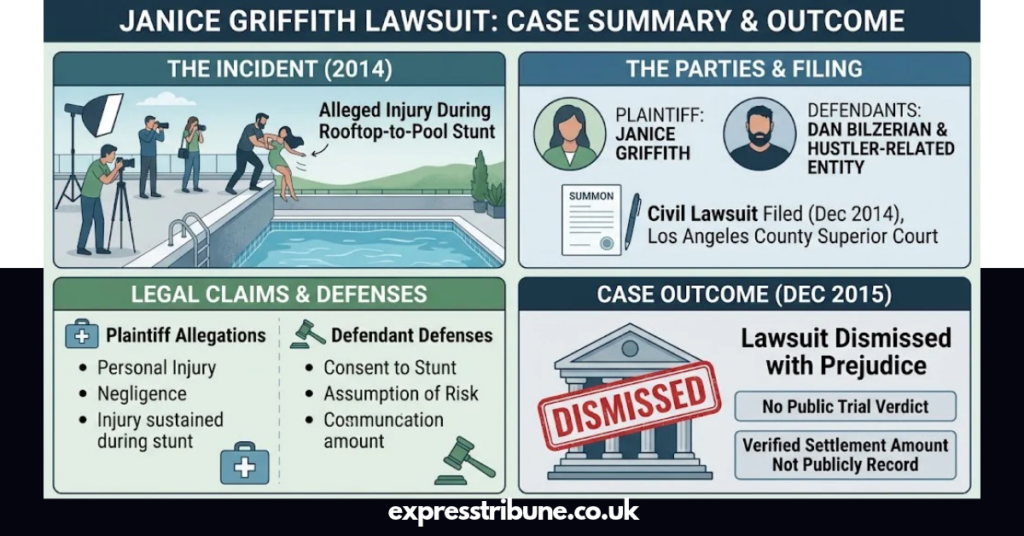

The janice griffith lawsuit was a personal injury case arising from a 2014 photo shoot involving Janice Griffith, Dan Bilzerian, and a Hustler-related company. Griffith alleged that she was injured during a rooftop-to-pool stunt and later filed a civil lawsuit in Los Angeles County.
The case became widely discussed because video of the stunt circulated online. However, the legal record is more specific than many internet summaries suggest: the lawsuit involved disputed allegations, defenses based on consent and risk, cross-claims between parties, settlement-related proceedings, and eventual dismissal without a public trial verdict.
The case was filed in December 2014, continued through 2015, and was dismissed with prejudice in December 2015. Publicly available records reviewed for this article do not establish a verified settlement amount or a jury verdict deciding liability.
Quick Facts About the Janice Griffith Lawsuit
| Detail | Information |
| Plaintiff | Janice Griffith |
| Main defendants | Dan Bilzerian and LFP Internet Group LLC |
| Related company | LFP Publishing Group LLC |
| Court | Superior Court of California, County of Los Angeles |
| Case number | BC566899 |
| Case type | Personal injury / tort |
| Incident | April 23, 2014 |
| Lawsuit filed | December 16, 2014 |
| Trial verdict | No public verdict identified |
| Final dismissal | December 2015 |
| Settlement amount | Not publicly verified |
| Current status | Closed |
The docket information identifies the matter as a Los Angeles County personal injury case and gives December 16, 2014 as the filing date.
What Happened to Janice Griffith?
The underlying incident happened during a Hustler-related photo shoot at Dan Bilzerian’s home in Los Angeles. Griffith was reportedly thrown from a rooftop toward a swimming pool as part of the planned stunt.
According to the complaint as reported by Courthouse News Service, Griffith said she was injured during the stunt and hurt her foot. She was 18 at the time of the incident.
The video later became widely circulated online. That publicity made the dispute much more visible than an ordinary personal injury lawsuit.
It is important to separate the video evidence from the ultimate legal question. A video can show what happened physically, but a court would still need to determine issues such as duty, negligence, consent, causation, and responsibility.
When Did Janice Griffith File the Lawsuit?
Griffith filed the civil complaint on December 16, 2014, in the Superior Court of California, County of Los Angeles.
The case was titled Janice Griffith v. LFP Internet Group LLC et al. and carried case number BC566899. Court-docket information classifies it as a personal injury/tort matter.
The complaint named Bilzerian and LFP Internet Group LLC, which was identified in reporting as doing business as Hustler Magazine. Later litigation also involved LFP Publishing Group LLC and cross-claims between parties.
What Did Griffith Claim in Her Lawsuit?
The reported allegations focused on the planning and execution of the rooftop stunt.
Griffith’s position was that the defendants were involved in the stunt and that the activity had been represented as safe. The claim therefore raised questions about whether reasonable precautions were taken and whether the parties involved were responsible for the resulting injury.
These were allegations made in civil litigation, not findings that a court ultimately confirmed.
The distinction matters because the case never produced a public trial judgment determining that the defendants were legally liable.
Who Did Janice Griffith Sue?
The principal parties can be summarized as follows:
| Party | Role | Connection to Case |
| Janice Griffith | Plaintiff | Filed the personal injury lawsuit |
| Dan Bilzerian | Defendant | Involved directly in the rooftop stunt |
| LFP Internet Group LLC | Defendant | Hustler-related entity named in the lawsuit |
| LFP Publishing Group LLC | Related defendant/cross-claim party | Became involved in later litigation |
| Nathaniel D. Smith | Cross-defendant | Appeared in later cross-claim proceedings |
The original filing reported by Courthouse News Service named Griffith, LFP Internet Group LLC, and Bilzerian. Later docket information shows additional procedural activity involving other parties.
What Was Dan Bilzerian’s Response?
Bilzerian’s legal position disputed responsibility for the injury.
His attorney argued that Griffith had voluntarily participated in the stunt and therefore had accepted risks associated with it. The defense also disputed how the failed landing occurred and raised the argument that Griffith’s own actions contributed to what happened.
These arguments became important because California law recognizes legal doctrines concerning assumption of risk in certain activities.
California’s Judicial Council explains that primary assumption of risk can apply to activities involving inherent risks, while the applicable duty can depend on the nature of the activity and the defendant’s role.
That does not mean the doctrine automatically decided Griffith’s case. No public trial verdict established that it did.
Could Consent Affect the Janice Griffith Lawsuit?
Yes. Consent and assumption of risk could be relevant to a personal injury dispute involving a planned stunt.
However, agreeing to participate in an activity does not automatically answer every negligence question. California’s legal framework can distinguish between risks that are inherent in an activity and conduct that allegedly increases the risk beyond what participants reasonably accepted.
For this particular case, the parties disputed what Griffith agreed to, how the stunt was performed, and who should bear responsibility for the injury.
Because the case did not proceed to a public merits verdict, there is no jury finding that conclusively resolves those competing positions.
What Were the Cross-Claims About?
The litigation became more complicated after the original complaint.
LFP Publishing Group filed a cross-complaint involving negligence, indemnity, and contribution. Bilzerian also filed a cross-complaint concerning indemnity.
In simple terms, these filings raised questions about how responsibility could be allocated among the parties if Griffith’s claims resulted in liability.
California law provides rules addressing allocation of responsibility in personal injury cases, including comparative-fault principles and proportional responsibility for certain damages.
Importantly, filing a cross-claim is not itself proof of liability. It is a procedural part of litigation in which parties assert claims against other parties.
Did the Janice Griffith Lawsuit Go to Trial?
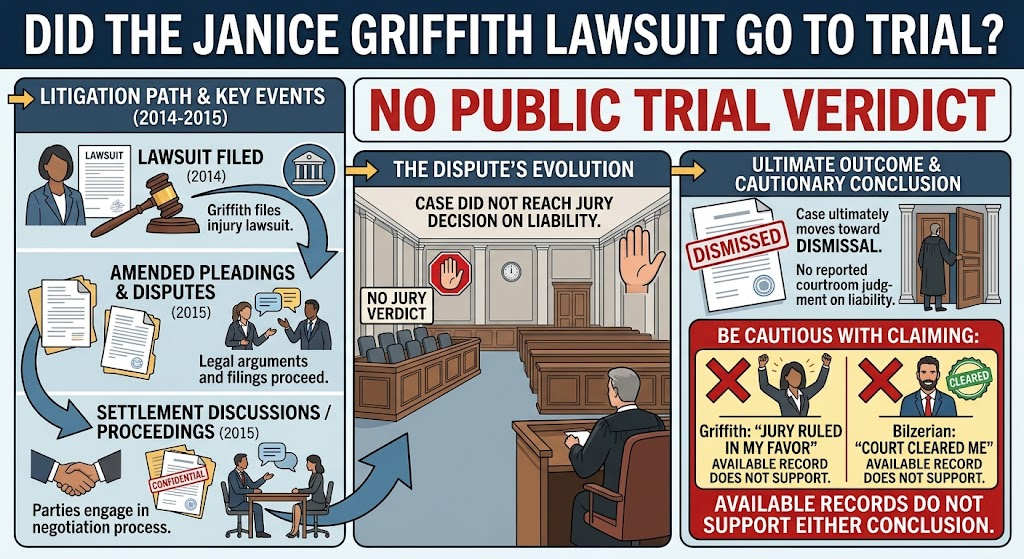
No public trial verdict has been identified in the available case information.
The litigation continued through 2015, including amended pleadings and settlement-related proceedings. The case ultimately moved toward dismissal rather than a publicly reported jury decision on liability.
This means readers should be cautious with articles claiming that a jury ruled Griffith was right or that Bilzerian was officially cleared. The available record does not support either conclusion.
Was There a Janice Griffith Settlement?
Settlement-related activity occurred before the case was dismissed.
However, the exact terms of any private settlement have not been publicly verified in the sources reviewed for this article. The case was dismissed with prejudice in December 2015, but a dismissal alone does not reveal the amount or terms of a confidential agreement.
This is one of the most important facts for anyone researching the janice griffith lawsuit.
What About the $85,000 Figure?
An $85,000 figure is often mentioned in online coverage of the dispute. That figure should not automatically be described as the amount Griffith received.
The available reporting connects $85,000 with a pre-lawsuit demand. That is different from a confirmed settlement payment or court-awarded damages.
Therefore:
- $85,000 should not be presented as a verified payout.
- No reliable public source reviewed here confirms the final settlement amount.
- There was no publicly reported jury award.
- The dismissal does not disclose confidential settlement terms.
When Was the Janice Griffith Lawsuit Dismissed?
The case moved toward closure in December 2015.
Docket information shows a request for dismissal with prejudice was filed by Griffith, followed by dismissal of the action and related cross-claims. The case therefore did not remain an active personal injury lawsuit after that period.
A dismissal with prejudice generally prevents the same claim from being brought again after the dismissal becomes final.
The important point is that the case ended without a public trial verdict determining liability.
Janice Griffith Lawsuit Timeline
| Date | Event |
| April 23, 2014 | Rooftop stunt and reported injury |
| December 16, 2014 | Griffith filed the personal injury lawsuit |
| January 2015 | LFP-related cross-claim activity began |
| February 2015 | Bilzerian filed a cross-complaint |
| July 2015 | Griffith filed an amended complaint |
| October 2015 | Settlement-related proceedings appeared |
| December 2015 | Griffith’s claim moved toward dismissal |
| December 28, 2015 | Further dismissal activity closed the litigation |
| 2016 | Later docket activity concerned remaining procedural/cost matters |
The case record confirms the lawsuit’s filing and later dismissal, while the publicly available material does not provide a court judgment awarding Griffith a specific amount.
What Is the Current Status of the Janice Griffith Lawsuit?
The case is closed.
The original lawsuit dates back to 2014, and dismissal occurred in 2015. There is no indication in the reviewed case information that the original lawsuit remains active today.
For readers searching for a current “Janice Griffith settlement claim,” there is another important distinction: this was an individual personal injury lawsuit, not a consumer class action with a public claims form.
There is therefore no verified public claim process connected to this case that allows unrelated people to apply for money.
Was Janice Griffith Awarded Money?
There is no publicly verified court award establishing a specific amount.
The case ended without a publicly reported jury verdict. Settlement-related activity occurred before dismissal, but the financial terms were not publicly established in the records reviewed.
That makes the following distinction useful:
| Statement | Status |
| Griffith filed a lawsuit | Confirmed |
| The lawsuit involved a rooftop stunt | Confirmed by contemporary reporting |
| The case was a personal injury matter | Confirmed |
| Bilzerian disputed responsibility | Reported |
| Settlement-related proceedings occurred | Reported in docket summaries |
| Case was dismissed | Confirmed |
| $85,000 was a pre-lawsuit demand | Reported |
| Griffith definitely received $85,000 | Not verified |
| A jury awarded Griffith damages | Not verified |
| A jury found Bilzerian liable | Not verified |
This distinction helps prevent outdated or exaggerated settlement claims from being repeated as established facts.
Why Does the Case Still Get Attention?
The janice griffith lawsuit remains searchable because it combines several elements that attracted significant public attention: a viral video, an unusual stunt, a recognizable internet personality, and a civil lawsuit involving disputed responsibility.
The legal questions are also broader than the video itself.
The dispute illustrates how personal injury cases can involve:
- Negligence
- Consent
- Assumption of risk
- Comparative fault
- Causation
- Production responsibility
- Cross-claims
- Settlement negotiations
- Confidential settlement terms
The case is therefore useful as an example of why a viral incident does not necessarily produce a simple legal answer.
Janice Griffith Lawsuit vs. Online Settlement Claims
Many online pages use terms such as “settlement,” “payout,” and “claim” without clearly explaining what the underlying court record establishes.
A better approach is to separate three things:
1. The Original Claim
Griffith filed a personal injury lawsuit alleging that the defendants were responsible for injuries connected to the rooftop stunt.
2. The Defense
Bilzerian’s side disputed liability and relied on arguments involving Griffith’s participation and the risks associated with the stunt.
3. The Final Record
The case ended through dismissal rather than a public trial verdict. The precise financial terms of any settlement have not been publicly verified.
This approach gives readers a more accurate picture than simply repeating a settlement figure without context.
Key Legal Lessons From the Case
The case raises several useful legal concepts, although it should not be treated as a legal precedent that decided these questions.
Assumption of Risk
California recognizes circumstances in which a participant may have accepted inherent risks associated with an activity. The precise application depends on the activity and the parties’ respective roles.
Comparative Fault
California law also recognizes comparative-fault principles. Where applicable, responsibility can affect how damages are allocated among parties.
Settlement Confidentiality
A civil lawsuit can end without a public trial. If the parties resolve a dispute privately, the public may not have access to the financial terms.
Dismissal With Prejudice
A dismissal with prejudice generally prevents the dismissed claim from simply being filed again by the same plaintiff against the same defendants.
Frequently Asked Questions
The janice griffith lawsuit was a personal injury case filed in Los Angeles Superior Court after Griffith reported an injury during a 2014 rooftop stunt connected to a Hustler photo shoot. She sued Dan Bilzerian and a Hustler-related company.
Griffith filed the lawsuit on December 16, 2014. The case was filed in the Superior Court of California, County of Los Angeles, under case number BC566899.
There was no public jury verdict establishing a winner. The case was dismissed in December 2015 after settlement-related proceedings, so describing either side as having won at trial would be inaccurate.
The exact amount has not been publicly verified in the sources reviewed. The frequently mentioned $85,000 figure relates to a reported pre-lawsuit demand, not a confirmed settlement payment.
No. The original case was dismissed in December 2015. The available docket information identifies the matter as a closed personal injury case.
No public class-action claims process has been identified for this case. It was an individual personal injury lawsuit involving Griffith and specific defendants, rather than a consumer settlement open to unrelated claimants.