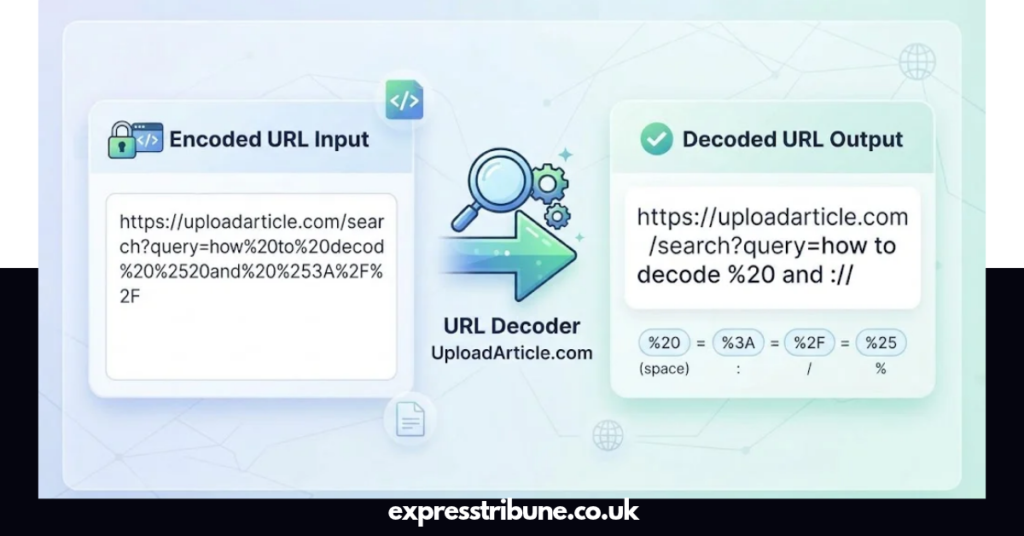

URL Decoder UploadArticle.com refers to an online URL decoding concept associated with UploadArticle.com. A URL decoder changes percent-encoded characters such as %20, %3A, %2F, and %3F back into readable characters.
For example:
hello%20world
becomes:
hello world
URL decoding is useful when you need to inspect query strings, campaign links, redirect URLs, encoded parameters, or web addresses that contain special characters.
What Is URL Decoder UploadArticle.com?
URL Decoder UploadArticle.com is a search phrase used for finding information about URL decoding and the UploadArticle.com-related URL tool. The basic job of a URL decoder is simple: it reverses percent encoding so encoded web data becomes easier for people to read.
A URL cannot freely use every character in every part of its structure. Percent encoding represents certain bytes with a % followed by two hexadecimal digits. RFC 3986 defines this mechanism as part of URI syntax.
For example:
| Encoded Code | Decoded Character | Common Meaning |
| %20 | Space | Blank space |
| %3A | : | Colon |
| %2F | / | Forward slash |
| %3F | ? | Question mark |
| %26 | & | Ampersand |
| %3D | = | Equals sign |
| %40 | @ | At symbol |
| %23 | # | Hash |
| %25 | % | Percent sign |
The important idea is that decoding does not create new information. It reverses an encoding representation.
Why Do URLs Need Encoding?
Web addresses contain structural characters that have special meanings. A question mark can begin a query, an ampersand can separate parameters, and a slash can separate path components.
When these characters are part of the actual data instead of the URL structure, encoding helps distinguish the data from the syntax. RFC 3986 describes percent encoding as a way to represent an octet when its character is outside the allowed set or conflicts with a delimiter.
Consider this search value:
red shoes & bags
The ampersand may have a special meaning inside a query string. Encoding the value can produce something similar to:
red%20shoes%20%26%20bags
A decoder can reverse that representation when you need to inspect the original text.
How Does URL Decoder UploadArticle.com Work?
URL Decoder UploadArticle.com follows the same basic principle used by URL decoding tools generally.
The process looks like this:
- You copy encoded URL text.
- You paste it into a decoder.
- The decoder identifies percent-encoded sequences.
- Each valid %XX sequence is interpreted as an encoded byte.
- The bytes are converted back into characters.
- The readable result is displayed.
For example:
https%3A%2F%2Fexample.com%2Fsearch%3Fq%3Dcoffee%20shop
can decode to:
https://example.com/search?q=coffee shop
The exact treatment of a value can depend on context. For example, HTML form encoding can use + for spaces, while ordinary percent encoding treats + as a literal plus sign. MDN documents this distinction clearly.
What Does %20 Mean in a URL?
One of the most common questions about URL Decoder UploadArticle.com is what %20 means.
Answer: %20 represents a space in percent encoding.
The number 20 is hexadecimal for the ASCII space character. RFC 3986 specifically gives %20 as an example of percent encoding.
For example:
best%20coffee
decodes to:
best coffee
You may also see a plus sign in form-encoded query data:
best+coffee
In application/x-www-form-urlencoded data, + can represent a space. That is different from strict percent decoding, where + itself can remain a plus sign.
URL Encoder vs. URL Decoder
It is easy to confuse an encoder and a decoder because they perform opposite jobs.
| Feature | URL Encoder | URL Decoder |
| Main purpose | Converts characters into encoded form | Converts encoded data back |
| Direction | Readable → encoded | Encoded → readable |
| Example | hello world → hello%20world | hello%20world → hello world |
| Main use | Preparing data for URL transmission | Inspecting or recovering readable data |
| Typical users | Developers, marketers, SEO professionals | Developers, analysts, SEO professionals |
| Main benefit | Helps represent data safely | Makes encoded data easier to understand |
A simple way to remember it is:
Encode = prepare the data.
Decode = read the encoded data.
What Are the Most Common URL Encoded Characters?
Understanding common codes makes URL troubleshooting much faster.
| Character | Percent Encoding | Example |
| Space | %20 | hello%20world |
| : | %3A | https%3A |
| / | %2F | %2Fblog |
| ? | %3F | %3Fsearch |
| & | %26 | red%26blue |
| = | %3D | id%3D123 |
| @ | %40 | name%40example.com |
| # | %23 | %23section |
| % | %25 | %25off |
| + | %2B | C%2B%2B |
MDN provides a broader reference for percent-encoded characters, including their hexadecimal representations.
How to Use URL Decoder UploadArticle.com Step by Step
If you are trying to decode a URL, the process is straightforward.
Step 1: Copy the Encoded Text
Find the URL, query parameter, or text containing codes such as %20, %3A, or %2F.
Step 2: Open the Decoder
Open the URL decoder page or another trusted decoding utility.
Step 3: Paste the Data
Place the encoded string into the input field.
Step 4: Decode the Value
Select the decode function if the tool provides separate encode and decode options.
Step 5: Review the Result
Check whether the decoded text makes sense.
Step 6: Check the Context
If the URL contains query parameters, make sure symbols such as &, =, ?, and # are being interpreted in the correct place.
Step 7: Test Before Publishing
If you are fixing a website link, test the final URL in a browser before publishing it.
This last step matters because decoding text and validating a complete URL are not exactly the same task.
Can URL Decoding Help With SEO?
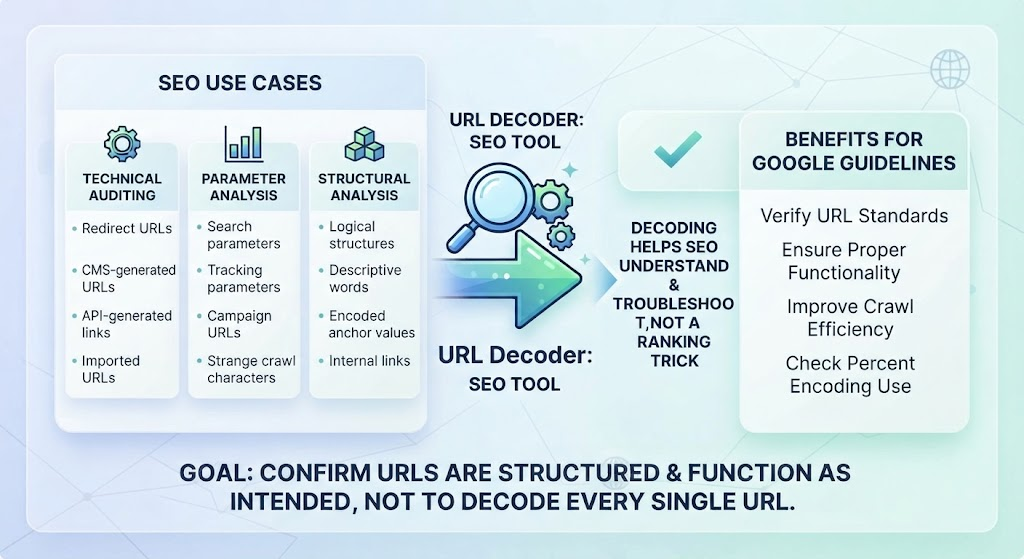
Yes, URL decoding can help SEO professionals understand and troubleshoot URLs, but decoding itself is not an SEO ranking trick.
Google recommends logical, understandable URL structures and explains that URLs should follow established URL standards. Google also recommends descriptive words and says to use percent encoding when necessary.
For SEO work, a decoder can help you inspect:
- Search parameters
- Tracking parameters
- Redirect URLs
- Internal links
- Encoded anchor values
- Campaign URLs
- API-generated links
- CMS-generated URLs
- Imported URLs
- Strange characters in crawled URLs
The goal is not to decode every URL on a website. The goal is to understand whether a URL is structured and functioning as intended.
URL Decoding for SEO Audits
A technical SEO audit may uncover URLs that look confusing because they contain encoded values.
For example:
https://example.com/search?q=best%20running%20shoes
The encoded value:
best%20running%20shoes
represents:
best running shoes
That information can make it easier to understand what a parameter contains.
Google also warns that overly complex URL structures can create crawling problems, especially when many parameters generate alternative URLs for similar content.
A decoder therefore works best as a diagnostic tool, not as a replacement for proper URL architecture.
Can URL Decoding Fix a Broken Link?
Not always.
A URL decoder can reveal what encoded characters represent, but it cannot automatically repair every broken URL.
A broken link could result from:
- An incorrect domain
- A deleted page
- A server error
- An invalid parameter
- Incorrect encoding
- Double encoding
- A malformed redirect
- An expired tracking URL
- Incorrect URL construction
For example, this:
hello%2520world
may indicate double encoding.
The first decoding pass can produce:
hello%20world
A second pass can produce:
hello world
This is why you should understand how many encoding layers exist before changing a URL.
What Is Double URL Encoding?
Double encoding happens when already encoded data gets encoded again.
Suppose the original text is:
hello world
After one encoding:
hello%20world
If the percent sign is encoded again, it can become:
hello%2520world
Why?
Because % itself can be represented as %25.
So:
%20
becomes:
%2520
when encoded a second time.
This issue commonly appears when applications pass URL parameters through multiple processing stages. A decoder can help identify the problem, but you should fix the underlying application logic rather than repeatedly decoding blindly.
URL Decoder UploadArticle.com vs. Browser Developer Tools
URL Decoder UploadArticle.com can be useful for quick manual checks, while developers may prefer built-in programming functions or browser tools for repeated work.
| Method | Best For | Skill Level |
| Online URL decoder | Quick manual checks | Beginner |
| Browser DevTools | Debugging web requests | Intermediate |
| JavaScript functions | Development work | Intermediate |
| Server-side libraries | Applications | Advanced |
| SEO crawlers | Large website audits | Intermediate/Advanced |
For JavaScript, developers commonly work with functions such as decodeURIComponent() when decoding individual URL components.
For large websites, a crawler or automated script is usually more practical than manually processing hundreds or thousands of URLs.
Is URL Decoding the Same as Base64 Decoding?
No.
This distinction is important.
URL decoding reverses percent encoding.
Base64 decoding converts Base64-formatted data back into its original byte representation.
For example:
hello%20world
uses URL percent encoding.
A Base64 value looks more like:
aGVsbG8gd29ybGQ=
These are different encoding systems and require different decoding methods.
Using a URL decoder on Base64 data will not magically recover the original message.
How URL Decoding Handles Non-English Text
Modern websites frequently use languages other than English.
Characters outside basic ASCII can require multiple percent-encoded bytes when represented in UTF-8. RFC 3986 explains that non-ASCII data can be encoded using UTF-8 and then represented through percent encoding.
For example, a URL may contain encoded characters representing:
- Arabic
- Urdu
- Chinese
- Japanese
- Korean
- Hindi
- Accented European characters
- Emoji
A correctly configured decoder should interpret the encoded bytes using the appropriate character encoding.
If the character set is handled incorrectly, the result may appear as unreadable symbols instead of the original text.
URL Decoding and Website Security
A URL decoder can help you inspect a link, but decoding a suspicious URL does not make the destination safe.
For example, if someone sends you an unfamiliar tracking or redirect URL, decoding it may reveal a hidden parameter or destination. You should still verify the domain before visiting it.
Never paste private information into an online tool if that information contains:
- Password reset tokens
- Authentication tokens
- Private API keys
- Session identifiers
- Personal access links
- Confidential customer information
A URL may contain sensitive information even when it looks like an ordinary web address.
For security analysis, decode first if necessary, inspect the destination, and avoid opening suspicious destinations directly.
What Should You Check After Decoding a URL?
After using URL Decoder UploadArticle.com, do not immediately assume the result is correct.
Use this checklist:
- Does the domain look familiar?
- Are the parameters readable?
- Is the intended destination visible?
- Are there unexpected redirects?
- Does the URL contain private information?
- Is the URL double encoded?
- Are query parameters separated correctly?
- Does the final URL use HTTPS?
- Does the page actually exist?
- Is the URL being used consistently across the website?
This approach turns decoding into a useful troubleshooting process instead of simply converting symbols.
Best Practices for Clean SEO-Friendly URLs
URL decoding and URL creation are related, but they are not identical.
When creating website URLs, Google recommends descriptive structures that are understandable to both users and search systems. Google also recommends using hyphens to separate words and percent encoding where necessary.
Follow these practical rules:
- Use descriptive words.
- Keep unnecessary parameters out of URLs when possible.
- Use hyphens between words.
- Avoid unnecessary URL complexity.
- Keep URL structures consistent.
- Encode characters when the URL standard requires it.
- Check redirects carefully.
- Avoid creating multiple URLs for the same content without a reason.
- Keep important pages internally linked.
- Test URLs before publishing them.
Google states that its systems are designed around helpful, reliable, people-first content rather than content created mainly to manipulate rankings.
Common URL Decoder Mistakes to Avoid
Decoding the Wrong Data
A URL may contain several components. Decoding an entire URL when only one parameter needs decoding can change the structure you intended to preserve.
Treating + as a Space Everywhere
A plus sign does not universally mean a space. Its meaning depends on the encoding context.
Ignoring Double Encoding
A value containing %25 may indicate that another percent-encoded layer exists.
Assuming Decoding Fixes Everything
Decoding only reverses encoding. It does not repair an incorrect domain, redirect, server response, or missing page.
Pasting Sensitive Tokens
Avoid putting private authentication or account information into third-party tools.
Changing URLs Without Testing
Always test a modified URL before replacing a live link.
URL Decoder UploadArticle.com: Practical Example
Imagine an analytics system gives you this URL:
https%3A%2F%2Fexample.com%2Fproducts%3Fcategory%3Dshoes%26color%3Dblack
At first glance, it is difficult to read.
After decoding, you can understand it as:
Now the URL structure is much clearer:
| Component | Value |
| Protocol | https |
| Domain | example.com |
| Path | /products |
| Parameter | category=shoes |
| Parameter | color=black |
This is where a decoder provides practical value. It turns encoded data into something you can inspect and understand.
Does URL Decoding Improve Google Rankings?
No, URL decoding by itself does not guarantee higher Google rankings.
A decoder is a technical utility. It can help you inspect and troubleshoot URL data, but ranking depends on many factors.
Google says that meeting its Search Essentials does not guarantee crawling, indexing, or ranking. It also emphasizes helpful, reliable, people-first content.
For SEO, focus on the complete picture:
- Useful content
- Search intent
- Crawlable pages
- Clear URL structures
- Internal linking
- Good page experience
- Accurate technical implementation
- Original information
- Trustworthy sources
- Strong site architecture
That is much more valuable than trying to use URL encoding as a ranking shortcut.
Trust Signals and Sources for URL Decoding
A trustworthy explanation of URL decoding should rely on technical documentation rather than unsupported claims.
The key references for this topic include:
- IETF RFC 3986 — Defines URI syntax and percent encoding.
- MDN Web Docs — Explains percent encoding and common encoded characters.
- Google Search Central — Provides URL structure and SEO guidance.
- Google Search Essentials — Covers technical requirements, spam policies, and people-first search practices.
- Google Helpful Content Guidance — Explains how to create useful, reliable content for people.
These sources provide stronger technical grounding than repeating claims from unrelated blogs.
URL Decoder UploadArticle.com: Quick Reference Table
| Question | Short Answer |
| What does a URL decoder do? | It reverses percent encoding. |
| What does %20 mean? | A space. |
| What does %2F mean? | A forward slash. |
| What does %3F mean? | A question mark. |
| What does %26 mean? | An ampersand. |
| What does %3D mean? | An equals sign. |
| What is URL encoding? | A way to represent characters using percent-encoded values. |
| What is URL decoding? | The reverse process. |
| Is URL decoding Base64 decoding? | No. They are different systems. |
| Can decoding repair a broken website? | No. It only reverses encoding. |
| Can URLs contain non-English text? | Yes, with appropriate encoding. |
| Is %2520 important? | It can indicate double encoding. |
| Is URL decoding an SEO ranking trick? | No. |
| Should private tokens be pasted into online tools? | No. |
Frequently Asked Questions
URL Decoder UploadArticle.com is a search term associated with URL decoding and an UploadArticle.com-related tool or page. URL decoding converts percent-encoded characters back into readable data.
%20 represents a space in percent encoding. For example, hello%20world represents hello world.
Encoding changes data into a URL-safe representation, while decoding reverses that representation. In simple terms, encoding prepares the data and decoding makes the encoded data readable again.
These codes represent characters with special meanings in URL syntax. %2F represents /, %3A represents :, and %3F represents ?.
URL decoding itself does not improve rankings. It can help SEO professionals understand parameters, troubleshoot links, and inspect complicated URLs, while Google recommends clear and logical URL structures.
Decoding is generally a straightforward transformation, but you should still protect private information. Do not paste passwords, session tokens, private API keys, or confidential URLs into tools you do not trust.
Conclusion:
URL Decoder UploadArticle.com is best understood through the broader concept of URL encoding and decoding. Once you know what %20, %2F, %3A, %3F, and %26 represent, complicated links become much easier to inspect.
The key is to use a decoder as a practical troubleshooting tool. Decode the right part of a URL, check for double encoding, understand the difference between percent encoding and form encoding, and always test important links before publishing them.