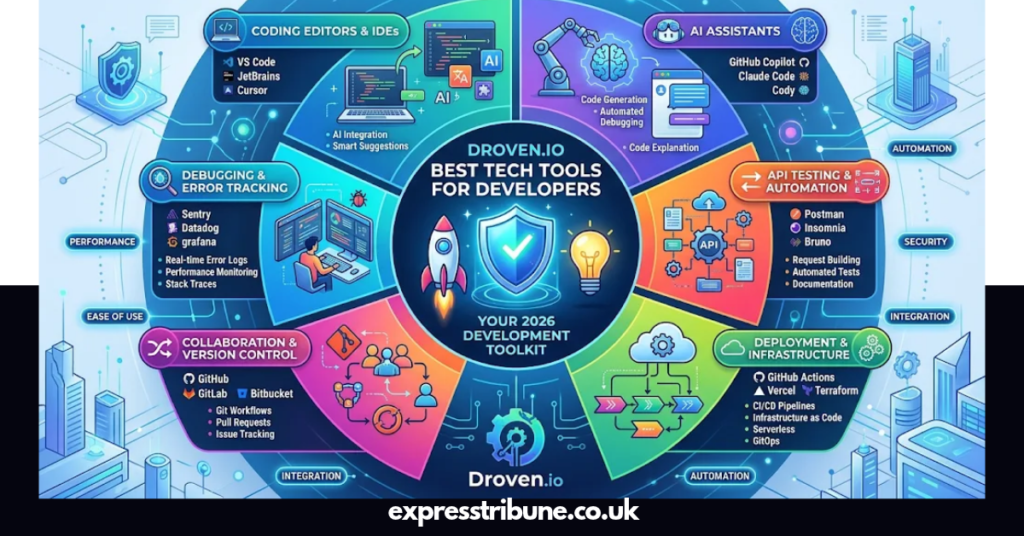

Choosing the right development software can make a major difference in how quickly and confidently developers build applications. However, finding reliable tools among hundreds of options can be difficult, especially when every platform promises better productivity. The search for droven. io best tech tools for developers reflects this need for practical recommendations. This guide explores established developer tools, their features, everyday uses, and limitations so you can build a toolkit that matches your projects.
What Is Droven.io?
Droven.io is an online technology and editorial website that publishes information about artificial intelligence, software, digital transformation, technology trends, and related subjects. Its website presents itself as an information resource rather than a downloadable programming application.
It is important to understand this distinction before exploring droven. io best tech tools for developers. Droven.io is not itself an integrated development environment (IDE), code editor, hosting provider, or API testing application.
Instead, developers can approach the topic as a guide to understanding useful software and technologies across the development process.
The website covers subjects that can help readers explore areas such as:
- Artificial intelligence and machine learning.
- Software and web development.
- Cloud computing and digital infrastructure.
- Cybersecurity and data protection.
- Automation and productivity.
- Technology reviews and emerging software.
You can visit the official website at Droven.io to explore its published technology content.
Why Do Developers Need the Right Technology Tools?
Software development involves much more than writing programming instructions. Developers must organize projects, manage code changes, test applications, communicate with APIs, fix errors, and maintain software after release.
Using appropriate tools makes these responsibilities easier to manage.
Here are some important benefits:
1. Faster development: Code editors, reusable components, and automation tools reduce repetitive work.
2. Better code quality: Debuggers and testing frameworks help identify problems before applications reach users.
3. Easier collaboration: Version control systems allow multiple developers to work on the same project while tracking changes.
4. Improved security: Dependency scanning, access controls, and secure development practices help reduce common risks.
5. Simplified deployment: Cloud platforms and automation tools make application releases more consistent.
Understanding these benefits gives context to the droven. io best tech tools for developers topic and helps developers select software based on actual requirements.
Droven.io Best Tech Tools for Developers: Complete Comparison Table
The following table compares established third-party developer products. These are independent examples, not an official Droven.io ranking or endorsement.
| Tool | Category | Main Purpose | Best For | Learning Level |
| Visual Studio Code | Code editor | Writing and editing code | Beginners and professionals | Beginner |
| GitHub Copilot | AI coding assistant | Code suggestions and explanations | Faster coding workflows | Beginner–Advanced |
| Cursor | AI code editor | AI-assisted project development | Developers working with larger codebases | Intermediate |
| Git and GitHub | Version control | Tracking and sharing code changes | Individual and team projects | Beginner–Advanced |
| Docker | Containerization | Creating consistent environments | Backend and DevOps development | Intermediate |
| Postman | API testing | Sending requests and testing APIs | Backend developers | Beginner–Intermediate |
| Playwright | Automated testing | Testing websites in browsers | Web application teams | Intermediate |
| GitHub Actions | CI/CD automation | Automating development workflows | Development teams | Intermediate |
| Vercel | Cloud deployment | Hosting web applications | Frontend developers | Beginner–Intermediate |
| Supabase | Backend platform | Database, authentication, and storage | Web and mobile developers | Intermediate |
| Sentry | Error monitoring | Tracking application errors | Production development teams | Intermediate |
Each product solves a different problem. The best choice depends on the programming language, project size, technical experience, budget, and development environment.
Visual Studio Code: A Flexible Code Editor
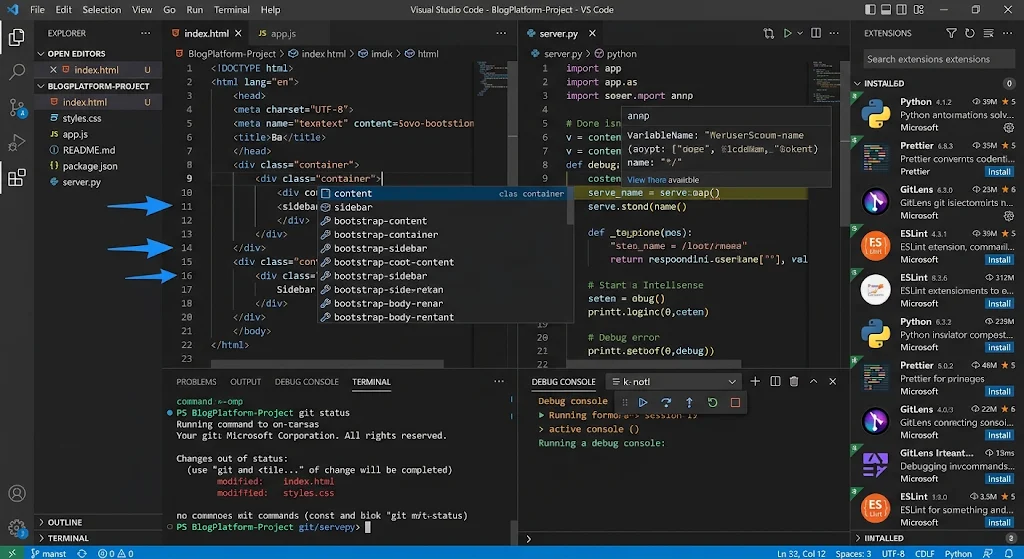
Visual Studio Code (VS Code) is a popular code editor developed by Microsoft. It provides developers with an environment for writing, editing, running, and debugging code.
Its flexible design supports many programming languages through built-in features and extensions.
Important Features
- Syntax highlighting for supported programming languages.
- IntelliSense for code completion and suggestions.
- Integrated terminal for running commands.
- Debugging tools for identifying programming errors.
- Git integration for managing source code.
- Extensions for additional languages and development workflows.
How Developers Can Use It
A beginner can use VS Code to create a basic HTML website, while an experienced developer can manage a larger JavaScript, Python, or TypeScript project.
The integrated terminal also allows developers to execute commands without constantly switching between applications.
Advantages and Limitations
Advantages:
- Free editor with extensive customization.
- Supports multiple programming languages.
- Large extension ecosystem.
- Useful debugging and source control features.
Limitations:
- Some advanced features require extensions.
- Too many extensions can affect performance.
- Developers must configure certain language environments themselves.
Best for: Beginners, web developers, Python programmers, and software engineers.
GitHub Copilot: AI Assistance for Programming
GitHub Copilot is an AI-powered coding assistant that helps developers write and understand code. It can suggest code completions, explain programming concepts, and assist with different development tasks.
It can be useful when working with unfamiliar libraries or handling repetitive programming work.
Important Features
- AI-powered code suggestions.
- Assistance with writing functions.
- Explanations of existing code.
- Support for common programming languages.
- Assistance with debugging and development tasks.
- Integration with supported development environments.
Practical Applications
A developer writing a Python function can use Copilot to suggest an initial implementation. They can then review the result, modify it, and run tests to confirm that it works correctly.
AI-generated code should never be accepted without review. Developers remain responsible for checking security, correctness, performance, and licensing requirements.
Advantages:
- Helps reduce repetitive coding.
- Provides programming explanations.
- Supports faster experimentation.
Limitations:
- Suggestions can contain errors.
- Generated code requires human review.
- Availability and features depend on the selected subscription and environment.
Best for: Developers who want AI assistance during everyday programming.
Cursor: An AI-Focused Development Environment
Cursor is an AI-focused code editor designed to help developers work with existing projects and create new software.
It offers an editing experience built around AI-assisted programming. Developers can ask questions about code, request changes, and work with project context.
Important Features
- AI-assisted code editing.
- Code explanations.
- Project-level code understanding.
- Assistance with refactoring.
- Support for navigating larger codebases.
- AI-supported development workflows.
How Cursor Helps Developers
Imagine working on a website with multiple files. Instead of manually searching through every file, you can ask an AI assistant to help locate a function or explain how different components connect.
You should still inspect suggested changes and test the application before using them.
Advantages:
- Convenient AI-focused editing experience.
- Helps explore unfamiliar projects.
- Can assist with repetitive development tasks.
Limitations:
- AI features may require a paid plan or usage credits.
- Suggestions can misunderstand project requirements.
- Developers need to review generated changes carefully.
Best for: Developers interested in AI-assisted coding and project-level editing.
Git and GitHub: Essential Version Control
Git is a distributed version control system that tracks changes in source code. GitHub is a hosting and collaboration platform built around Git repositories.
Together, they help developers maintain project history, organize branches, review changes, and collaborate with other programmers.
Important Features
- Repository management.
- Branch creation and merging.
- Commit history.
- Pull requests and code reviews.
- Issue tracking.
- Collaboration across development teams.
Practical Example
Suppose two developers are building a website. One works on the login system while another develops the homepage.
They can create separate branches, work independently, and later combine their changes through a review process.
Git also allows developers to examine previous versions when a new update causes a problem.
Advantages:
- Tracks code changes.
- Supports teamwork.
- Makes project history easier to manage.
- Helps developers organize releases.
Limitations:
- Merge conflicts can confuse beginners.
- Poor commit practices make project history difficult to understand.
- Git and GitHub require some initial learning.
Best for: Every developer who works on projects that require reliable code management.
Docker: Consistent Development Environments
Docker is a containerization platform that allows developers to package applications and their required dependencies into containers.
Containers help software run more consistently across development, testing, and production environments.
Important Features
- Container creation and management.
- Docker images.
- Dockerfiles for defining environments.
- Container networking.
- Persistent data through volumes.
- Docker Compose for managing multi-container applications.
Why Is Docker Useful?
A common development problem occurs when an application works on one computer but fails on another because of different software versions or dependencies.
Docker helps reduce this issue by providing a defined environment for running the application.
For example, a team can configure a web application with a specific Node.js version and database service. Other team members can use the same configuration rather than manually installing every dependency.
Advantages:
- More consistent environments.
- Useful for testing and deployment.
- Supports microservices architecture.
- Helps isolate application dependencies.
Limitations:
- Requires learning container concepts.
- Resource usage can increase with multiple containers.
- Incorrect configuration can create security and networking problems.
Best for: Backend developers, DevOps engineers, and teams working with multiple services.
Postman: API Development and Testing
Postman is an API development and testing platform. It helps developers send requests to APIs, inspect responses, organize collections, and create automated tests.
It is especially useful when building applications that communicate with external services or backend systems.
Important Features
- HTTP request creation.
- API response inspection.
- Authentication configuration.
- Request collections.
- JavaScript-based test scripts.
- API documentation and collaboration.
- Automated test execution.
How Developers Use Postman
Suppose you are developing an online shopping application. You need to check whether the product API returns the correct product information.
You can send a GET request through Postman and inspect the response.
You can also test POST requests, authentication, error handling, and other API operations.
Advantages:
- Beginner-friendly interface.
- Helps identify API problems.
- Supports reusable request collections.
- Useful for manual and automated testing.
Limitations:
- Large collections need proper organization.
- Some advanced collaboration capabilities depend on the plan.
- Developers must understand API behavior to create meaningful tests.
Best for: Backend developers, API engineers, and full-stack programmers.
Playwright: Automated Browser Testing
Playwright is an open-source browser automation and testing framework. It helps developers test web applications by simulating user interactions in supported browsers.
It is useful for checking whether important website features work correctly before releasing updates.
Important Features
- Browser automation.
- Automated end-to-end tests.
- Support for Chromium, Firefox, and WebKit.
- Screenshots and test reports.
- Browser interaction testing.
- Automatic waiting for actionability checks.
Practical Applications
A developer can write a Playwright test that opens a website, enters login details, clicks the login button, and checks whether the dashboard appears.
This makes it easier to identify problems that might otherwise require repeated manual testing.
Advantages:
- Supports multiple browser engines.
- Automates repetitive testing.
- Helps detect user-facing problems.
- Integrates with development workflows.
Limitations:
- Requires knowledge of test writing.
- Complex applications need carefully maintained test suites.
- Poorly designed tests can become unreliable.
Best for: Frontend developers, QA engineers, and web application teams.
GitHub Actions: Automating Development Workflows
GitHub Actions is an automation platform that allows developers to run workflows directly from GitHub repositories.
It is commonly used for continuous integration and continuous delivery (CI/CD).
Important Features
- Automated builds.
- Test execution.
- Workflow configuration.
- Repository event triggers.
- Deployment automation.
- Integration with third-party actions.
How It Improves Development
A developer can configure a workflow to run tests whenever someone pushes code to a repository.
If a test fails, the team receives feedback before merging the changes.
This reduces the need to perform every repeated check manually.
Advantages:
- Integrates with GitHub repositories.
- Automates common development tasks.
- Helps maintain consistent testing practices.
- Supports customized workflows.
Limitations:
- Workflow configuration requires YAML knowledge.
- Incorrect permissions can create security risks.
- Usage limits and billing depend on the account and runner configuration.
Best for: Development teams that want automated testing and deployment.
Vercel: Deploying Modern Web Applications
Vercel is a cloud platform designed to build, deploy, and host web applications. It is particularly associated with frontend development and frameworks such as Next.js.
It helps developers publish websites and manage deployment workflows without maintaining every part of the hosting infrastructure themselves.
Important Features
- Git-based deployments.
- Preview deployments.
- Production deployments.
- Custom domains.
- Framework integrations.
- Deployment management.
Practical Applications
A frontend developer can connect a GitHub repository to Vercel and configure automatic deployments when code changes.
Preview deployments also help teams review proposed updates before publishing them to the production website.
Advantages:
- Convenient deployment workflow.
- Useful for modern frontend projects.
- Preview environments support collaboration.
- Reduces some hosting management tasks.
Limitations:
- Pricing depends on the selected plan and usage.
- Some projects need additional backend infrastructure.
- Platform-specific features may affect portability.
Best for: Frontend developers, website creators, and teams using supported frameworks.
Supabase: Backend Development Made More Accessible
Supabase is an open-source-based backend platform built around PostgreSQL. It provides services that help developers create applications without building every backend component from scratch.
It is particularly useful for projects that need databases, authentication, file storage, and real-time functionality.
Important Features
- PostgreSQL database.
- User authentication.
- File storage.
- Realtime functionality.
- Database APIs.
- Access control through Row Level Security.
How Developers Can Use Supabase
Imagine building a task management application. Users need accounts, task records, and a database to store their information.
Supabase can provide authentication and database services for this application. Developers can then focus more on the application’s features and user experience.
Advantages:
- PostgreSQL-based database.
- Several backend services in one platform.
- Useful for prototypes and production applications.
- Reduces the need to build common backend features independently.
Limitations:
- Requires database knowledge for advanced projects.
- Security policies need careful configuration.
- Usage and pricing depend on the selected plan.
Best for: Full-stack developers, startups, and mobile application developers.
Sentry: Application Error Monitoring
Sentry is an application monitoring platform that helps development teams identify and investigate errors.
Finding bugs before release is important, but developers also need to understand problems that appear after an application becomes available to users.
Sentry helps provide that visibility.
Important Features
- Error tracking.
- Stack traces.
- Performance monitoring.
- Issue grouping.
- Release tracking.
- Application diagnostics.
Why Developers Need Error Monitoring
Suppose an application starts producing errors after a new update. Without monitoring, developers might depend on user complaints to discover the issue.
An error monitoring platform can help identify the affected application area and provide technical information for investigation.
Advantages:
- Helps identify production errors.
- Provides diagnostic information.
- Supports multiple development technologies.
- Helps teams investigate performance problems.
Limitations:
- Requires proper configuration.
- Monitoring data needs interpretation.
- Pricing and event limits depend on the plan.
Best for: Developers maintaining live websites, APIs, and mobile applications.
How to Choose the Best Developer Tools for Your Project
Selecting software based on popularity alone can lead to unnecessary subscriptions and complicated workflows.
A better approach is to identify the problem you want to solve and compare tools against your requirements.
Consider these factors before making a decision.
1. Identify Your Development Requirements
Start by understanding your project.
Are you creating a website, mobile application, API, desktop program, or cloud-based service?
Different projects require different technologies. A simple website may need an editor and hosting platform, while a complex backend application may require containers, automated tests, and monitoring.
2. Check Programming Language Compatibility
Make sure the tool supports your preferred language and framework.
For example:
- Python developers may prefer an editor with strong Python support.
- JavaScript developers can benefit from browser testing and Node.js integrations.
- Backend engineers may need API testing and database management tools.
- DevOps engineers often work with containerization and infrastructure automation.
3. Compare Free and Paid Plans
Check the available features, usage limits, and subscription costs.
A free plan may be sufficient for learning or small projects. However, larger teams may need additional collaboration, security, storage, or deployment capabilities.
Always verify current pricing on the official product website.
4. Consider Security and Privacy
Developer tools may access source code, credentials, databases, and sensitive project information.
Before adopting a platform, review its privacy policies, permission settings, data handling practices, and security documentation.
Never place API keys or passwords directly into public repositories.
5. Evaluate Learning Requirements
A powerful application is not automatically the right choice for every developer.
Choose software that matches your experience and gives you a clear path to improve your skills.
Beginners can start with VS Code and Git before moving into advanced tools such as Docker and Kubernetes.
Which Developer Tools Are Best for Beginners?
New programmers do not need to learn every development platform at once.
A small collection of tools can support the most important stages of learning.
| Learning Goal | Recommended Tool | Why It Helps |
| Writing code | Visual Studio Code | Provides a flexible coding environment |
| Learning Git | Git and GitHub | Teaches version control and collaboration |
| Understanding programming | GitHub Copilot | Offers coding assistance and explanations |
| Learning APIs | Postman | Makes API requests easier to understand |
| Testing websites | Playwright | Introduces automated browser testing |
| Publishing websites | Vercel | Simplifies supported web deployments |
| Learning databases | Supabase | Provides access to PostgreSQL and backend services |
A beginner-friendly learning path could look like this:
- Learn HTML, CSS, and JavaScript or another programming language.
- Install Visual Studio Code.
- Learn basic Git commands and create a GitHub repository.
- Build a small project.
- Learn how APIs work with Postman.
- Practice automated testing.
- Deploy a project using a suitable hosting platform.
This approach builds practical skills without overwhelming new developers.
How AI Is Changing Modern Software Development
Artificial intelligence is becoming an important part of software development. AI coding assistants can help developers understand unfamiliar code, generate suggestions, explain errors, and complete repetitive tasks.
Tools such as GitHub Copilot and Cursor provide examples of how AI assistance can fit into programming workflows.
However, AI does not remove the need for software engineering knowledge.
Developers must still understand:
- Programming logic.
- Application architecture.
- Database design.
- Security principles.
- Testing methods.
- Code performance.
- User requirements.
AI-generated code can contain incorrect assumptions, security weaknesses, or inefficient solutions. Always review the output and test it against the actual requirements.
The most effective approach is to use AI as an assistant rather than treating it as an automatic replacement for technical judgment.
Common Mistakes to Avoid When Selecting Developer Tools
Even experienced programmers can make poor technology choices when they focus too much on trends.
Avoid these common mistakes:
Installing too many applications: Multiple tools with overlapping features can make workflows harder to manage.
Ignoring documentation: Official documentation explains supported features, configuration requirements, and limitations.
Choosing software without testing it: Try a tool on a small project before making it part of your main workflow.
Overlooking security: Review access permissions and protect credentials when connecting external services.
Adopting advanced infrastructure too early: Small projects rarely need the same infrastructure as large enterprise applications.
Depending completely on AI-generated code: Review, test, and understand every important code change.
These practical considerations make the droven. io best tech tools for developers discussion more useful than a simple list of software names.
How to Build a Productive Developer Toolkit
You can create an effective development environment by combining tools that serve different purposes.
Here is a practical example of a modern development workflow:
| Development Stage | Suggested Tool | Main Activity |
| Planning | GitHub Issues | Organizing tasks |
| Coding | Visual Studio Code | Writing application code |
| AI assistance | GitHub Copilot or Cursor | Getting coding support |
| Version control | Git and GitHub | Managing code changes |
| Local environment | Docker | Running consistent environments |
| API development | Postman | Testing API requests |
| Quality assurance | Playwright | Automating browser tests |
| Automation | GitHub Actions | Running builds and tests |
| Deployment | Vercel | Publishing supported web projects |
| Backend | Supabase | Managing database and authentication |
| Monitoring | Sentry | Investigating application errors |
You do not need every product in this table. Start with the tools that solve your immediate problems and expand your setup as your application grows.
Are Droven.io Developer Tool Recommendations Suitable for Every Programmer?
No single collection of software works equally well for every programmer.
A beginner learning frontend development may need an editor, Git, and a simple deployment service. A backend developer may prioritize databases, API testing, and containerization.
Meanwhile, a DevOps engineer may need infrastructure automation, CI/CD pipelines, and monitoring solutions.
When exploring droven. io best tech tools for developers, use the topic as a starting point for discovering relevant technologies rather than treating any list as a universal ranking.
Check the official documentation, test available features, and compare the tools against your actual development requirements.
Frequently Asked Questions
Droven.io is an editorial technology website that publishes information about AI, software, technology, and digital transformation. It is an information resource, not a downloadable IDE or developer software suite.
Popular developer tools include Visual Studio Code, GitHub Copilot, Cursor, GitHub, Docker, Postman, Playwright, Vercel, Supabase, and Sentry. The best combination depends on your project and development requirements.
Visual Studio Code is a useful starting point because it supports multiple programming languages, extensions, debugging, and integrated terminal features. Beginners should also learn Git and GitHub for version control.
Yes. AI coding assistants can suggest code, explain functions, and help with repetitive programming tasks. However, developers must review generated code and test it before using it in production.
Many developer tools offer free versions, open-source editions, or limited free plans. However, advanced features, higher usage limits, and team services may require paid subscriptions.
Identify your project requirements, programming language, budget, security needs, and experience level. Test suitable options and select tools that solve real problems without adding unnecessary complexity.
Conclusion
Choosing suitable development software is an important step toward building better applications and managing projects efficiently. From Visual Studio Code and GitHub to Docker, Postman, Playwright, and Sentry, each tool supports a different part of the software development process.
The droven. io best tech tools for developers topic is best approached as an opportunity to discover established technologies and understand where they fit into modern programming workflows. Droven.io provides technology-related editorial content, while the products discussed in this guide are independent tools with their own developers and documentation.
Start with a few essential applications, learn how to use them properly, and expand your toolkit when your projects require additional capabilities. Which developer tool has made the biggest difference in your workflow? Share your experience and help other developers discover useful solutions.