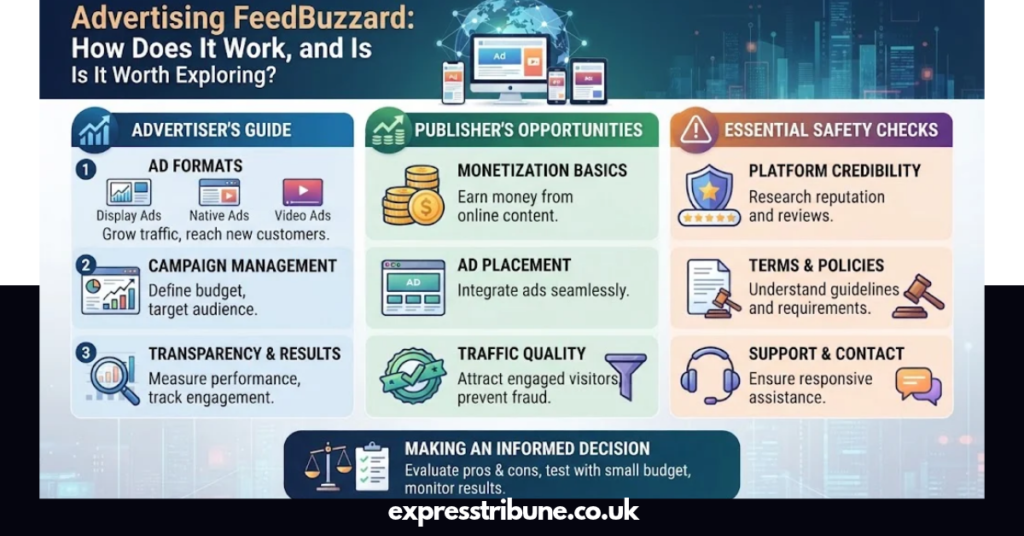

Choosing an advertising platform can feel confusing when you want to grow website traffic, reach new customers, or earn money from online content. The wrong choice can waste your budget, attract visitors who never engage, or make it difficult to measure results. Understanding advertising FeedBuzzard starts with identifying what the service actually offers, checking its transparency, and learning how digital advertising works. This guide explains the essential checks, advertising concepts, publisher considerations, and practical steps to help you make an informed decision.
What Is Advertising FeedBuzzard?
Advertising FeedBuzzard is a search phrase associated with promotional opportunities and digital marketing content related to FeedBuzzard. People searching this term may want to promote a business, publish sponsored content, increase website visibility, or learn how advertising opportunities work.
However, it is important to distinguish between advertising on a publishing website and using a dedicated advertising network. These services can have different features, pricing structures, audience data, and campaign management tools.
The FeedBuzzard website has published material about advertising and promotional opportunities. Its advertising-related page discusses brand promotion, sponsored content, and business visibility.
Before treating FeedBuzzard as a full advertising network, confirm the services currently available directly with the relevant website.
How Does Advertising FeedBuzzard Work?
The exact process depends on the advertising service offered, the type of campaign, and the agreement between the advertiser and publisher. A typical direct advertising arrangement follows these steps.
Step 1: Define your campaign goal
Decide whether you want brand awareness, product exposure, referral traffic, leads, or sales.
Step 2: Contact the publisher
Ask about available advertising placements, sponsored articles, audience demographics, and current pricing.
Step 3: Agree on the campaign details
Confirm the placement, duration, content requirements, payment terms, and reporting arrangements in writing.
Step 4: Measure the results
Track referral visits, engaged sessions, inquiries, conversions, and campaign costs.
These are general steps for direct digital advertising, not a verified description of a specific FeedBuzzard advertising dashboard or automated campaign system.
What Advertising Options Should You Check?
Different advertising formats serve different purposes. Ask the publisher which options are actually available before paying for a campaign.
| Advertising format | Main purpose | What to confirm |
| Banner advertising | Display a visual brand message | Position, dimensions, and display duration |
| Sponsored articles | Explain a product or service | Editorial requirements and disclosure |
| Featured content | Increase visibility for selected content | Placement location and time period |
| Product promotion | Introduce a product to readers | Audience relevance and referral tracking |
| Brand announcements | Share company news or launches | Publishing schedule and content limits |
| Newsletter promotion | Reach email subscribers | Subscriber count and engagement data |
| Display advertising | Generate impressions or clicks | Inventory, pricing, and reporting |
Important: This table describes common digital advertising formats. It does not confirm that FeedBuzzard currently offers every format listed.
Who Can Benefit From Advertising FeedBuzzard?
The usefulness of a publishing website depends on whether its audience matches your potential customers. A campaign can generate impressions without producing meaningful business results if readers have little interest in the advertised product.
Potential advertisers may include:
- Small businesses introducing new products.
- Technology companies promoting software or online tools.
- Startups building early brand awareness.
- Digital agencies promoting professional services.
- E-commerce businesses seeking relevant referral traffic.
- Established companies announcing launches or updates.
- Content creators promoting educational resources.
For example, a software company might use a sponsored article to explain a practical problem its product solves. A local retailer, by contrast, may need evidence that the website attracts readers from its service area.
Before investing in advertising FeedBuzzard, compare your intended audience with the site’s actual readership rather than relying on general promotional claims.
Advertising FeedBuzzard Pricing and Budget Planning
Advertising costs can vary based on placement, audience size, campaign duration, content production, and the publisher’s pricing model. Do not assume that a particular price or minimum budget applies without a current quotation.
The following table explains common pricing models used across digital advertising.
| Pricing model | Meaning | Example calculation |
| CPM | Cost per 1,000 impressions | 20,000 impressions at $5 CPM = $100 |
| CPC | Cost per click | 200 clicks at $0.50 = $100 |
| CPA | Cost per acquisition | 10 conversions at $10 each = $100 |
| Flat fee | Fixed price for an agreed placement | $100 for one agreed sponsored placement |
| Package pricing | Combined price for multiple placements | Depends on the written offer |
These figures are illustrative examples, not FeedBuzzard’s verified rates.
How to Calculate a Campaign Budget
Suppose a business spends $100 on a promotional campaign and receives 200 visitors.
The cost per visitor is:
\[ \text{Cost per visitor}=\frac{\$100}{200}=\$0.50 \]
If five visitors become customers, the cost per acquisition is:
\[ \text{Cost per acquisition}=\frac{\$100}{5}=\$20 \]
You can then compare the acquisition cost with the profit generated by each customer. This gives you a more useful measure than impressions or clicks alone.
For advertising FeedBuzzard, request clear pricing and measurable delivery commitments before approving your budget.
How to Check FeedBuzzard’s Audience and Traffic Quality
Website traffic quality matters more than a large visitor count alone. A campaign that reaches fewer relevant readers may generate more useful leads than one that attracts many visitors who leave immediately.
Before purchasing an advertising placement, request the following information:
- Monthly visitors: Ask for recent traffic figures and the reporting period.
- Audience locations: Confirm the percentage of visitors from your target countries.
- Traffic sources: Understand how visitors discover the website.
- Engagement: Review time spent on pages and other meaningful activity.
- Referral reporting: Ask whether the publisher can provide campaign-specific links.
- Historical campaign results: Request examples where the publisher can share genuine, verifiable data.
You can also use Google Analytics to measure visits and user activity on your own website. Keep your campaign links separate so you can identify visitors from individual placements.
Do not rely on screenshots alone when evaluating advertising FeedBuzzard. Ask how the figures were collected, which dates they cover, and whether they represent actual visitors, page views, or estimated reach.
How to Create an Effective Advertising Campaign
A clear message helps readers understand your offer quickly. Use these practical steps to prepare a campaign.
Step 1: Choose one primary goal
Select a measurable objective, such as:
- Increasing qualified website visits.
- Collecting business inquiries.
- Generating product sales.
- Promoting a new service.
- Building awareness of a brand.
Step 2: Understand your audience
Describe the people you want to reach. Consider their interests, location, needs, purchasing habits, and the problems they want to solve.
Step 3: Write a useful advertisement
Create a headline that communicates a specific benefit. Explain what the product does, why it matters, and what the reader can do next.
Step 4: Use a relevant landing page
Send visitors to a page that matches the advertisement. If the ad promotes a particular product, avoid directing every visitor to an unrelated homepage.
Step 5: Track results
Use tagged URLs, analytics tools, and conversion tracking where available. Google’s official documentation explains how conversion measurement connects advertising interactions with purchases, sign-ups, calls, and other business actions.
Advertising FeedBuzzard vs. Traditional Digital Advertising
The term advertising FeedBuzzard may refer to direct promotion through a publishing website, whereas traditional digital advertising often involves buying inventory through a dedicated advertising platform.
| Feature | Direct website advertising | Traditional ad network |
| Buying process | Often involves contacting the publisher | Often managed through an advertiser account |
| Placement | Agreed website or content placement | May cover multiple websites or apps |
| Pricing | May use fixed fees or negotiated packages | May use CPC, CPM, CPA, or automated bidding |
| Audience targeting | Depends on publisher capabilities | Depends on the network and campaign type |
| Reporting | Depends on the agreement | Usually provided through platform reports |
| Creative control | Agreed with the publisher | Governed by platform specifications and policies |
| Best measurement approach | Referral traffic and conversions | Clicks, impressions, conversions, and cost |
Neither arrangement guarantees sales. Results depend on audience relevance, creative quality, pricing, website experience, and campaign execution.
Sponsored Content, SEO, and Brand Visibility
Sponsored content can introduce a company, explain a product, or provide helpful information to potential customers. It may also create a referral path to the advertiser’s website.
However, paid placement does not guarantee improved Google rankings. A publisher’s audience, editorial quality, and the usefulness of the content are separate from the SEO value of a link.
When evaluating advertising FeedBuzzard, ask how sponsored articles are labeled, whether links are marked appropriately, and whether the publisher maintains editorial standards.
The US Federal Trade Commission’s guidance on native advertising explains why paid promotional material should be clearly identifiable when its format might otherwise mislead readers. Applicable disclosure requirements vary by jurisdiction.
For SEO purposes, focus on useful content, genuine audience relevance, transparent sponsorship, and links that serve readers rather than buying placements solely to manipulate search rankings.
Safety Checks Before You Pay
A professional-looking website does not automatically establish that every advertising offer is genuine or effective. Perform basic checks before sharing payment information or signing an agreement.
Advertiser verification checklist
Confirm the exact website domain and contact details.
Request a written quotation and campaign agreement.
Verify the advertising placement on the live website or preview.
Ask for dated audience and traffic reports.
Check payment terms, refund rules, and cancellation conditions.
Confirm tracking, reporting frequency, and delivery commitments.
Review sponsorship disclosures and content requirements.
Avoid guaranteed traffic, sales, or ranking promises without evidence.
0 of 8 checks completed
Reset
These checks help you evaluate a proposal without assuming that the website is either trustworthy or untrustworthy before reviewing its evidence.
How to Contact FeedBuzzard About Advertising
The first step is to identify the exact FeedBuzzard domain you want to work with. Search results show multiple websites using similar names, and their services should not be assumed to be connected.
One FeedBuzzard-related website publishes an advertising contact address, ads@feedbuzzard.co, on its contact page.
We’d Love to Hear From You
Confirm that this domain matches the website you intend to advertise on before sharing sensitive information or sending payment.
When contacting a publisher, include:
- Your business name and website.
- Your campaign objective.
- Your target audience and countries.
- Your preferred advertising format.
- Your estimated budget and campaign dates.
- Your tracking and reporting requirements.
Sample Advertising Inquiry Email
Hello FeedBuzzard Team,
I am interested in exploring advertising opportunities on your website.
Could you please share details about your available advertising formats, current pricing, audience demographics, monthly traffic, placement options, and campaign reporting?
I would also appreciate information about sponsored content requirements, campaign duration, payment terms, and any minimum advertising budget.
Please share your current media kit or advertising proposal so I can review the available options.
Thank you for your time. I look forward to hearing from you.
Best regards,
[Your Name]
[Company or Website]
How to Measure Advertising FeedBuzzard Performance
After launching a campaign, review the results against the goal you selected before spending money. This helps you determine whether the placement delivered useful business outcomes.
| Metric | What it measures | Why it matters |
| Impressions | Number of times an ad appears | Shows exposure, not necessarily unique people |
| Clicks | Number of ad clicks | Indicates interaction with the placement |
| Click-through rate (CTR) | Clicks divided by impressions | Helps evaluate how often people click |
| Referral sessions | Visits arriving from the campaign | Shows traffic reaching your website |
| Conversion rate | Conversions divided by visits or clicks, as defined | Measures completion of a desired action |
| Cost per lead | Advertising spend divided by qualified leads | Helps evaluate lead-generation costs |
| Return on ad spend (ROAS) | Attributed revenue divided by ad spend | Measures revenue relative to advertising cost |
For example, if a campaign generates 1,000 impressions and 20 clicks, its click-through rate is 2%.
\[ CTR=\frac{20}{1,000}\times100=2\% \]
A 2% CTR does not automatically mean that the campaign succeeded. You should also consider visitor quality, conversions, revenue, and the total cost of acquiring a customer.
Google’s guidance on advertising measurement recommends using metrics aligned with campaign objectives rather than relying on clicks and impressions alone.
Common Mistakes to Avoid With FeedBuzzard Advertising
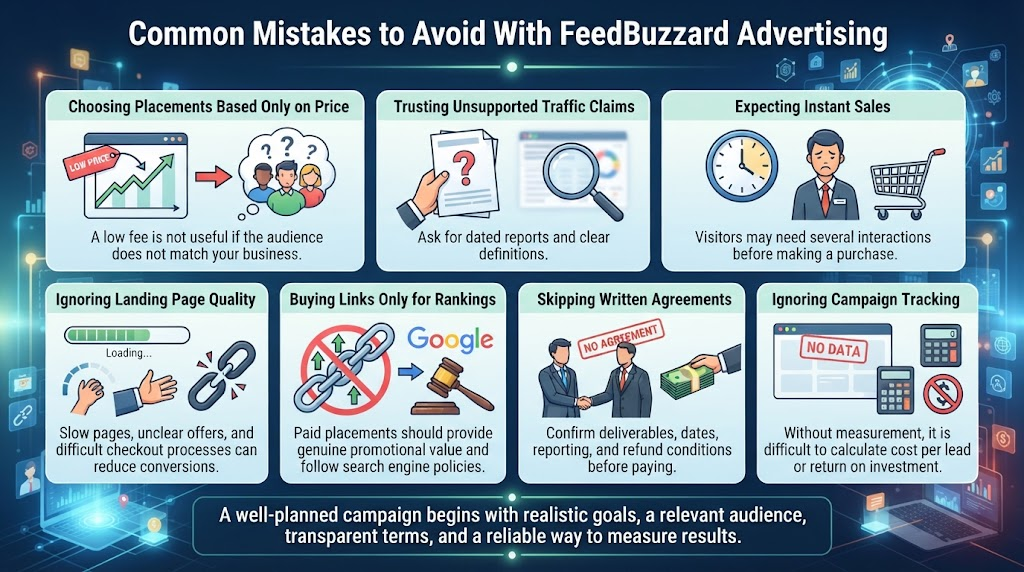
Avoid these mistakes when planning an advertising campaign:
- Choosing placements based only on price: A low fee is not useful if the audience does not match your business.
- Trusting unsupported traffic claims: Ask for dated reports and clear definitions.
- Expecting instant sales: Visitors may need several interactions before making a purchase.
- Ignoring landing page quality: Slow pages, unclear offers, and difficult checkout processes can reduce conversions.
- Buying links only for rankings: Paid placements should provide genuine promotional value and follow search engine policies.
- Skipping written agreements: Confirm deliverables, dates, reporting, and refund conditions before paying.
- Ignoring campaign tracking: Without measurement, it is difficult to calculate cost per lead or return on investment.
A well-planned campaign begins with realistic goals, a relevant audience, transparent terms, and a reliable way to measure results.
Practical Tips to Get More Value From Advertising FeedBuzzard
Use these recommendations to improve your campaign planning.
- Start with a small test. Avoid committing a large budget before verifying traffic quality.
- Prepare more than one headline. Compare different messages if the publisher allows creative testing.
- Use a clear call to action. Tell readers whether they should learn more, request a quote, or explore a product.
- Keep campaign links organized. Use tracking parameters to separate traffic sources.
- Review results regularly. Look for meaningful visits and conversions rather than focusing only on exposure.
- Document the agreement. Keep copies of quotations, invoices, placement details, and reports.
- Compare alternative channels. Evaluate the results alongside other advertising methods using the same business goals.
For advertising FeedBuzzard, these steps provide a practical framework for testing a placement while limiting unnecessary spending.
Frequently Asked Questions
Advertising FeedBuzzard refers to researching or using promotional opportunities associated with FeedBuzzard. These may involve brand promotion, sponsored content, or other direct advertising arrangements, depending on the specific website and its current services.
Start by identifying the correct website and contacting its advertising team. Request a current media kit, available placements, pricing, audience information, payment terms, and reporting details before agreeing to a campaign.
The exact cost cannot be confirmed from the available information. Pricing may depend on the format, placement, duration, and campaign requirements. Request a current written quotation rather than relying on estimated rates.
A paid placement may generate referral traffic if readers see and click the advertisement. Actual results depend on audience relevance, content quality, placement visibility, and the offer. Traffic volume and quality should be measured separately.
Advertising does not guarantee better organic rankings. Sponsored content may introduce your brand to readers, but buying links specifically to influence rankings can conflict with Google’s spam policies. Prioritize relevant content, transparent sponsorship, and appropriate link attributes.
Verify the exact domain, contact details, placement, pricing, and payment terms. Request recent traffic evidence and a written agreement. Do not rely on guaranteed rankings, sales, or visitor numbers without independently verifiable evidence.
Conclusion
Advertising FeedBuzzard is a topic worth researching if you are exploring website promotion, sponsored content, or direct digital advertising. Before investing, establish which website you are dealing with, confirm the advertising services it currently provides, and request clear evidence about its audience, pricing, and campaign reporting.
Focus on measurable outcomes rather than promises. A sensible test budget, relevant promotional content, transparent sponsorship, and reliable tracking can help you understand whether a placement contributes to your business goals.