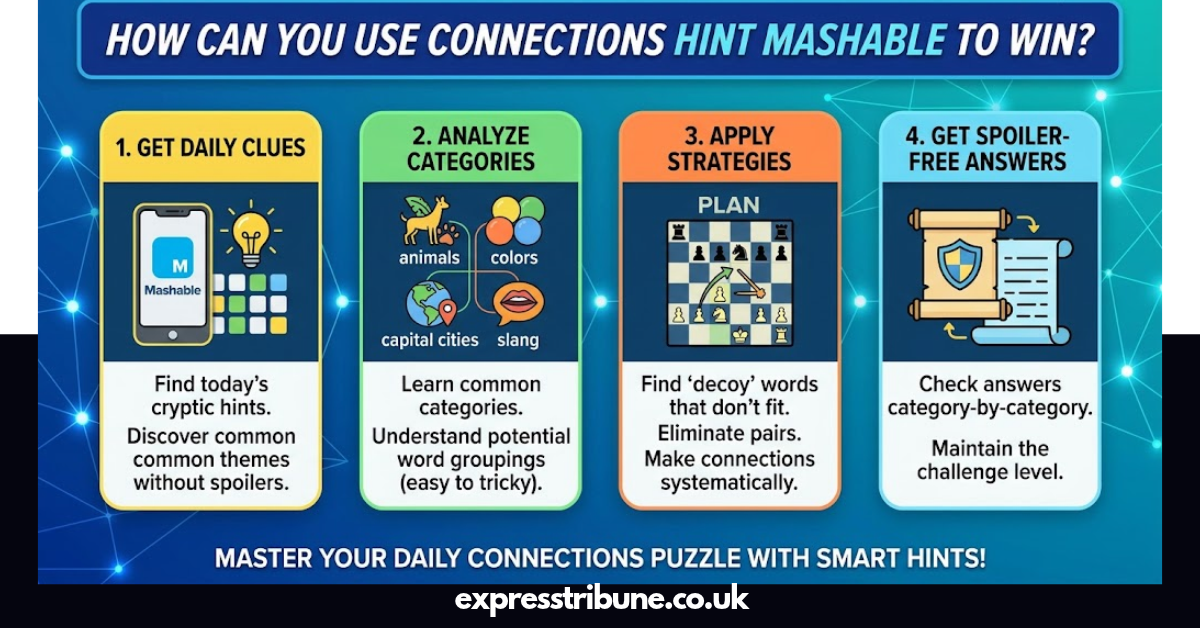
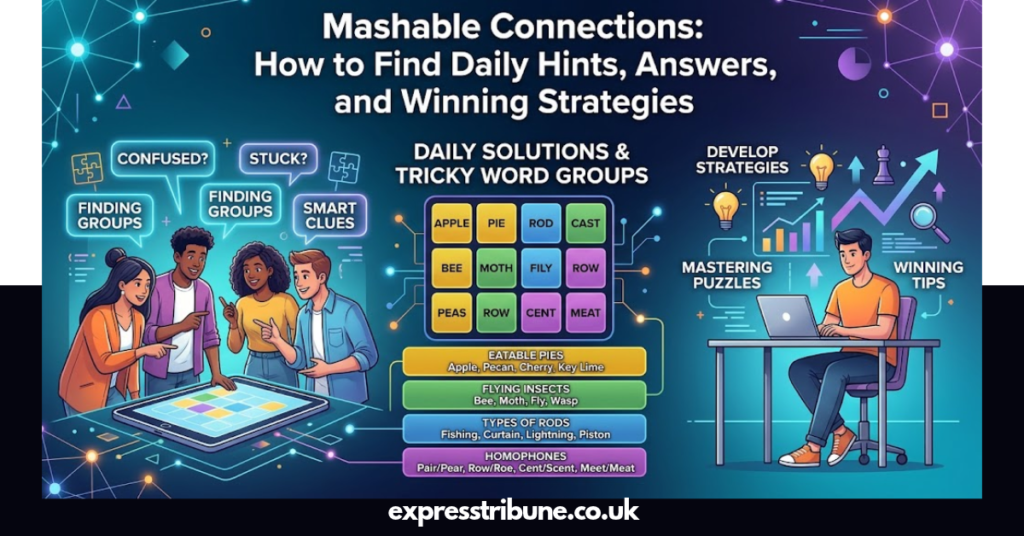

Getting stuck on a daily word puzzle can turn an enjoyable challenge into a frustrating experience. Finding the correct groups is not always easy, especially when several words appear to share the same meaning. Mashable Connections is a popular search term among players looking for helpful clues, category explanations, and solutions to the New York Times Connections puzzle. This guide explains how the puzzle works, where to find useful hints, and how to improve your solving skills without spoiling the fun.
What Is Mashable Connections?
Mashable Connections refers to the puzzle hints and answer guides that readers look for through Mashable’s coverage of the New York Times Connections game.
It is important to understand that Mashable and the original Connections game are separate. The New York Times publishes the game, while Mashable provides editorial coverage that helps readers understand difficult puzzles.
Players generally search for this information when they want to:
- Find clues for the daily Connections puzzle.
- Understand confusing word relationships.
- Check category names and complete answers.
- Learn why certain words belong together.
- Solve difficult groups without wasting guesses.
- Discover strategies for future puzzles.
The main benefit of using a hint guide is that players can choose how much assistance they need. They can start with a small clue and move toward the complete solution only when necessary.
How Does the NYT Connections Puzzle Work?
The Connections puzzle challenges players to identify relationships between 16 words. The objective is to organize those words into four separate groups, with exactly four words in each group.
Every group shares a hidden connection. The relationship might involve similar meanings, famous names, common expressions, objects, places, or word patterns.
For example, consider these eight words:
| Group | Words | Connection |
| Group 1 | Apple, Banana, Orange, Grape | Fruits |
| Group 2 | Chair, Table, Sofa, Desk | Furniture |
These examples show how four different words can belong to one category.
Real puzzles are more challenging because some words have multiple meanings. A word might appear suitable for two different categories, but only one combination matches the intended answer.
What Do the Four Connections Colors Mean?
Each completed category receives a color that represents its difficulty level. Understanding these colors can help players decide which group to solve first.
Y
Yellow – Easiest
Usually features familiar words and straightforward relationships.
G
Green – Moderate
Requires more attention to meanings and specific categories.
B
Blue – Challenging
Often involves less obvious relationships or general knowledge.
P
Purple – Hardest
Often uses wordplay, hidden meanings, spelling patterns, or unusual expressions.
These colors help communicate the intended difficulty, but individual players may find different categories easier or harder.
What Can You Find in Mashable Connections Hints?
Players looking for Mashable Connections usually want more than a list of four answers. They want enough information to understand the puzzle and identify the correct relationships.
A typical hint guide can include several types of assistance:
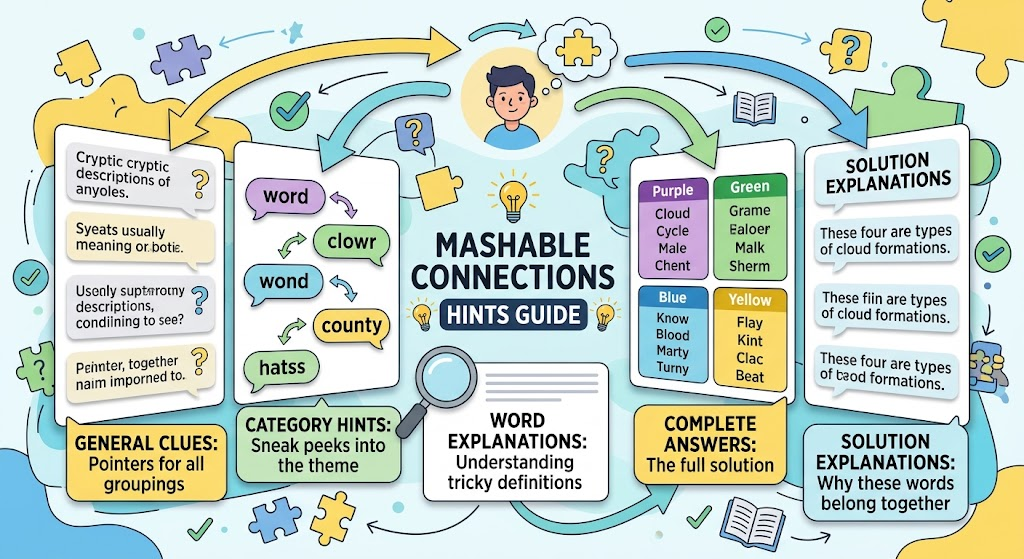
- General clues: Short suggestions about the hidden category.
- Category hints: More specific information about the relationship.
- Word explanations: Details about unfamiliar or confusing words.
- Complete answers: All four words listed under their correct categories.
- Solution explanations: Reasons why the selected words belong together.
This information supports different playing styles. Beginners can use detailed explanations, while experienced players may only need one small clue.
How to Find the Correct Mashable Connections Guide
Finding the correct daily guide is important because every Connections puzzle has its own words and categories.
Follow these steps to avoid opening an outdated solution:
- Open Mashable’s website.
- Navigate to its games coverage.
- Search for the Connections hints article.
- Check the publication date and puzzle number, if provided.
- Compare the guide with your current puzzle.
- Read the hints before moving to the complete answers.
A quick date check can prevent confusion when an older article appears in search results.
Important: Do not assume that an article is current simply because it appears near the top of a search page.
How to Use Mashable Connections Hints Without Spoilers
Not every player wants to see the complete solution immediately. Some enjoy solving most of the puzzle independently and only need help with one difficult category.
A gradual hint approach can protect that experience.
| Step | Type of assistance | What you learn |
| 1 | General hint | The broad topic of a category |
| 2 | Stronger clue | A more specific relationship |
| 3 | Category name | The exact theme connecting the words |
| 4 | Complete answer | All four correct words |
| 5 | Explanation | Why the words belong together |
Start with the first clue and return to your puzzle.
If you still cannot identify the relationship, move to the next level. This approach provides useful assistance without removing the entire challenge.
Why Is the Connections Puzzle Sometimes Difficult?
The puzzle uses more than simple vocabulary matching. It tests how players interpret words and recognize relationships.
Several factors can make a seemingly easy board difficult.
Multiple meanings: A word can have different meanings depending on how someone uses it.
Misleading combinations: Four words may appear connected even when they belong to separate categories.
Unfamiliar references: Some puzzles include historical figures, entertainment, sports, or cultural references.
Wordplay: A category might depend on spelling, pronunciation, missing letters, or words hidden inside longer terms.
Specific relationships: The game may expect a narrow connection rather than a broad similarity.
Understanding these challenges makes it easier to approach each new board with a clear strategy.
How Many Mistakes Can You Make in Connections?
The standard Connections game gives players four mistakes before the puzzle ends.
Each incorrect submission uses one mistake. This means random guessing can quickly reduce your chances of completing the puzzle successfully.
Before submitting a group, check whether all four words share the same specific relationship.
For example, four words might all relate to entertainment, but that connection may be too broad. Look for a more precise category that explains every selection.
The best approach is to make fewer, more carefully considered guesses.
Best Strategies to Solve Daily Connections Puzzles
Improving at word-grouping games requires observation, patience, and a little practice. You do not need an advanced vocabulary to become a better player.
Here are practical strategies that can help.
1. Read All 16 Words First
Do not select the first four words that seem related.
Read the entire board before making a decision. Sometimes a word near the bottom reveals the connection between words you initially overlooked.
2. Identify the Most Obvious Category
Look for familiar groups such as:
- Types of food.
- Animals.
- Countries.
- Sports.
- Household objects.
- Musical instruments.
- Famous personalities.
Solving an obvious category reduces the number of remaining words and makes the next groups easier to identify.
3. Look for Multiple Word Meanings
Some words can function as nouns, verbs, names, or parts of expressions.
Consider every reasonable interpretation before choosing a group.
For example, the word “bat” can refer to an animal or a piece of sports equipment. This type of ambiguity can create misleading combinations.
4. Watch for Red Herrings
A red herring is a misleading connection that makes an incorrect group appear convincing.
Do not submit a combination simply because the words share one general idea.
Ask yourself whether the same relationship explains all four words clearly.
5. Look for Common Phrases
Some categories depend on expressions rather than individual definitions.
Try placing a word before or after a familiar phrase. You may discover that several words complete the same expression.
6. Check Names and Popular References
Proper nouns can create unexpected connections.
Look for:
- Famous singers.
- Actors.
- Writers.
- Fictional characters.
- Sports personalities.
- Well-known brands.
A group that initially appears unrelated may become obvious when you recognize the names.
7. Leave Difficult Groups Until Later
You do not have to solve the hardest category first.
Find the strongest connections and remove those words mentally. Then examine the remaining board with fewer possibilities.
8. Use the One-Away Clue Carefully
When the game indicates that a submitted group is one away, it means three selected words belong to the intended category.
Use that information to reconsider the fourth word.
However, avoid repeatedly changing random selections. Review the meanings and look for the missing connection.
How Does Mashable Connections Compare With Other Puzzle Help Websites?
Several websites publish information about daily word puzzles. Each may offer a different style of assistance.
| Platform | Main purpose | Type of assistance | Best use |
| Mashable | Digital media and games coverage | Hints, clues, answers, explanations | Finding editorial puzzle guidance |
| The New York Times Games | Official puzzle platform | Original Connections game | Playing the daily challenge |
| Independent puzzle guides | Puzzle-related information | Strategies, clues, and solutions | Exploring additional explanations |
| Word-game communities | Player discussions | Suggestions and shared solving experiences | Discussing difficult categories |
Mashable is useful for readers who want editorial guidance, while the New York Times remains the original source of the game.
Players should use the official game for the actual puzzle and treat third-party explanations as supporting material.
What Is the Difference Between Connections Hints and Answers?
Hints and answers serve different purposes.
A hint gives you information about the hidden relationship without necessarily identifying every word.
An answer reveals the complete category and its four correct selections.
Consider this simple example:
| Assistance level | Example |
| General hint | Think about things found in a kitchen. |
| Stronger clue | These items are commonly used for cooking. |
| Category | Cooking utensils |
| Complete answer | Spoon, spatula, whisk, ladle |
This format makes it easier to understand how a small clue can guide you toward the solution.
Players who enjoy solving independently should start with hints. Those who simply want to check their results can move directly to the answers.
How Can Beginners Improve Their Connections Skills?
Beginners can improve through regular practice and by reviewing the categories they find difficult.
A few simple habits can make a noticeable difference.
- Learn common synonyms and word relationships.
- Read unfamiliar words and check their meanings.
- Pay attention to popular expressions.
- Practice identifying categories in everyday situations.
- Review mistakes instead of immediately starting another puzzle.
- Notice how words can have more than one meaning.
- Avoid rushing through submissions.
It also helps to understand why a wrong combination looked convincing. That lesson can make a similar puzzle easier next time.
Can You Play Connections on Different Devices?
The New York Times Connections game can be accessed through its official digital platforms, subject to the service’s current availability and requirements.
Players can generally use a compatible web browser or supported mobile experience.
Before playing, make sure that:
- Your internet connection is working.
- Your browser is updated.
- You are using the official game page.
- Your device supports the required website features.
- You have checked any applicable account or access requirements.
For the original game, visit The New York Times Connections.
Why Do People Search for Mashable Connections Every Day?
Daily puzzles create a reason for players to return regularly. Each new board offers different words, hidden relationships, and difficulty levels.
People search for this topic for several reasons:
- Daily assistance: They want help with a difficult puzzle.
- Answer checking: They want to confirm their selected groups.
- Time saving: They need a quick explanation instead of spending too long on one category.
- Learning: They want to understand unfamiliar words and expressions.
- Puzzle improvement: They want to develop better solving techniques.
- Spoiler control: They prefer hints instead of immediate answers.
This combination of entertainment and mental challenge explains why daily word puzzles attract regular audiences.
Common Mistakes to Avoid When Using Connections Hints
Even a useful guide cannot guarantee a correct result if players misunderstand the clues.
Avoid these common mistakes:
- Reading the complete answers before attempting the puzzle.
- Using an outdated daily guide.
- Ignoring the puzzle number.
- Assuming every word has only one meaning.
- Selecting four words based on a vague similarity.
- Submitting groups without checking the remaining board.
- Treating a hint as a guaranteed answer.
- Relying on random guesses instead of logical connections.
A better approach is to use clues as supporting information and make your own final decisions.
Frequently Asked Questions
Mashable Connections refers to Mashable’s editorial coverage of the New York Times Connections word puzzle. Players use its guides to find daily clues, category hints, answers, and explanations.
Visit Mashable’s website and look for its daily Connections coverage. Always check the article date and puzzle number to make sure you are reading the correct guide.
No. The New York Times publishes the original Connections game. Mashable provides separate editorial content that helps readers understand and solve its puzzles.
Each standard puzzle contains 16 words. Players must organize them into four groups, with four words sharing a particular connection in each group.
Players receive four incorrect guesses. After reaching the mistake limit, they cannot continue solving that puzzle and can review the correct answers.
The colors represent the intended difficulty levels. Yellow is generally the easiest, followed by green, blue, and purple, which is usually the most challenging.
Yes. Depending on the article, readers can find category clues, theme names, and complete solutions. Reading only the initial hints can help prevent unwanted spoilers.
Some words have multiple meanings or belong to several possible categories. The puzzle uses these overlapping relationships to make players think carefully before submitting their answers.
Both are daily word games from The New York Times, but they use different challenges. Wordle asks players to identify one hidden five-letter word, while Connections requires grouping 16 words into four related categories.
Start with obvious categories, examine alternative word meanings, watch for misleading combinations, and leave difficult wordplay categories until you have fewer words to consider.
Conclusion
Mashable Connections is a useful search topic for players who want daily puzzle assistance, category hints, complete answers, and practical solving strategies. Understanding the relationship between Mashable’s editorial guides and the original New York Times game helps readers find the right information without confusing the two platforms.
The best way to enjoy the puzzle is to attempt the challenge first, use hints when necessary, and review the explanations after solving. With regular practice, careful observation, and a better understanding of word relationships, you can develop stronger puzzle-solving skills.
Ready for your next challenge? Open the official Connections game, test your skills, and see how many categories you can solve without revealing the answers.