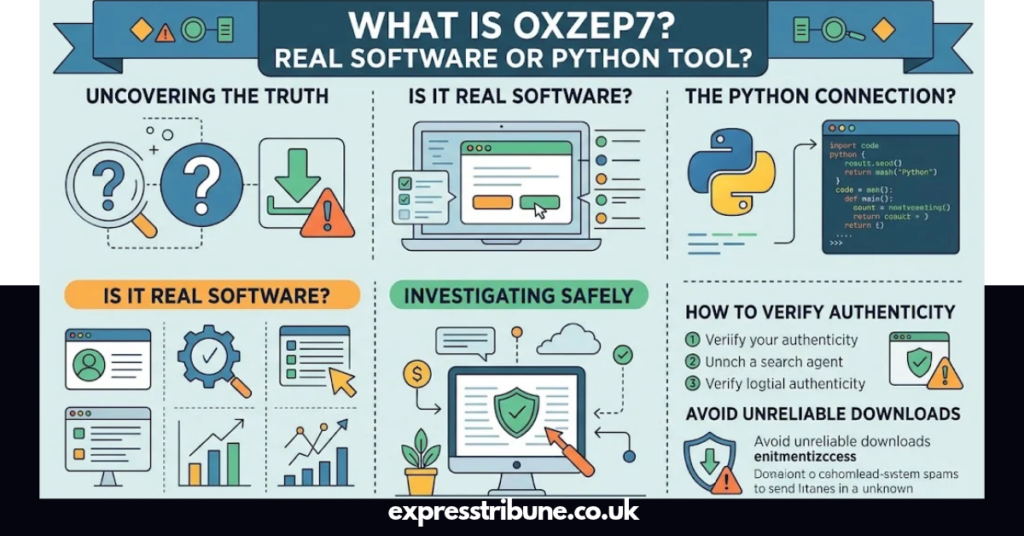

Finding an unfamiliar software name can create confusion, especially when different websites describe it in different ways. Oxzep7 is one such term that raises questions about its purpose, technical features, and connection to Python. Without reliable documentation, users may struggle to separate facts from online claims. This guide explains what can currently be verified about oxzep7, how to investigate it safely, and which practical steps help you avoid unreliable downloads or misleading technical advice.
What Is Oxzep7?
Oxzep7 is an unfamiliar technical term that appears in online discussions about software and Python development. However, the available evidence does not establish a single, authoritative definition of the name or confirm that it represents a recognized public software product.
Some online articles describe it as a Python-related tool, development framework, or automation system. Those descriptions should not be treated as confirmed product features without supporting documentation from an identifiable developer.
Before using oxzep7, establish what it refers to in the specific context where you found it.
For example, the term could be:
- A private software project or internal company identifier.
- A package name used in a particular development environment.
- A project code, reference number, or configuration label.
- A misspelled name copied from a tutorial or error message.
- An unverified label repeated across websites.
These are possibilities, not confirmed explanations. The name alone does not prove that a particular application or framework exists.
Why Is Oxzep7 Appearing in Software Searches?
Unfamiliar technical keywords can attract attention because users want to understand a new tool, fix an error, or find installation instructions. When several websites publish articles about the same term, search results may create the impression that it belongs to an established technology.
However, repeated online mentions do not independently prove that software exists or performs the advertised functions.
This problem can become more confusing when different pages provide conflicting explanations. One may call oxzep7 a development framework, while another may describe it as an error or automation tool.
To understand the term, look for evidence such as an official website, a source-code repository, a package registry entry, and documentation that agrees on the software’s purpose.
Is Oxzep7 a Real Python Package?
There is currently insufficient reliable public evidence to identify oxzep7 as an established, publicly documented Python package.
Python is a programming language with an official documentation website and a package ecosystem that includes the Python Package Index, commonly called PyPI. These resources help developers identify packages and understand how to install and use them.
You can investigate an unfamiliar package by checking:
- PyPI: Search for the exact package name and review its project information.
- Official documentation: Look for installation instructions, supported versions, and examples.
- Source code: Check whether a repository exists and whether its contents match the published description.
- Maintainer details: Look for identifiable authors or an organization responsible for the project.
- Release history: Review versions, change logs, and maintenance activity.
A missing public listing does not rule out a private package or an internal company tool. It does mean that you should not assume the name refers to a publicly available product.
For reference, consult the official Python documentation and Python Package Index.
What Is the Connection Between Oxzep7 and Python?
The phrase “Oxzep7 Python” suggests a connection with the Python programming language, but the wording itself does not establish that connection.
Python supports many types of development, including web applications, automation scripts, data processing, scientific computing, and machine learning. A genuine Python package normally provides some technical evidence explaining how it fits into this ecosystem.
If you encountered oxzep7 inside a Python project, inspect the surrounding code and configuration before deciding what it means.
For example, the name may appear in:
- An import statement.
- A requirements.txt file.
- A pyproject.toml configuration file.
- A dependency lock file.
- An application log or error message.
- A private package repository.
The location matters because the same name can serve different purposes in different projects. Do not install a package or change your Python environment based on the name alone.
What Features Does Oxzep7 Offer?
The features of oxzep7 cannot be reliably listed without verified product documentation.
Some online descriptions associate the term with automation, software development, or programming workflows. However, these claims do not establish that oxzep7 actually provides those functions.
The following table separates possible claims from the evidence needed to verify them.
| Feature or claim | Current evidence | What to check |
| Python integration | Not independently confirmed | Official documentation and source code |
| Task automation | Not verified | Demonstration or documented use case |
| Developer framework | Not established | Installation guide and technical specification |
| API support | Not confirmed | Official API reference |
| Data processing | Not confirmed | Working examples and tests |
| Artificial intelligence features | Not confirmed | Product documentation and model details |
| Cross-platform support | Not confirmed | Supported operating systems |
| Open-source availability | Not established | Public repository and license |
| Commercial availability | Not established | Official vendor or product page |
| Security updates | Not confirmed | Release history and security policy |
This distinction helps readers avoid confusing a description published online with a feature demonstrated by the actual software.
How Can You Verify Oxzep7 Before Using It?
The safest approach is to identify the source before attempting installation. A clear verification process can save time, prevent configuration problems, and reduce exposure to suspicious downloads.
Follow these steps:
Step 1: Find the original source. Identify the website, repository, developer, or organization that introduced the name.
Step 2: Check the technical documentation. Look for a clear description of the software, supported versions, installation process, and expected results.
Step 3: Verify the download location. Confirm that the download comes from a source associated with the actual developer.
Step 4: Inspect the code or package metadata. Review the package description, dependencies, license, and available source code where applicable.
Step 5: Test cautiously. If the software’s identity becomes clear and testing is appropriate, use a disposable virtual environment or isolated test machine rather than your main working environment.
Step 6: Confirm the result. Check whether the program behaves as documented and whether it introduces unexpected network activity, file changes, or permission requests.
Do not disable security software simply because an installation guide tells you to. An unfamiliar tool should provide a clear reason for every permission it requests.
Is Oxzep7 Safe to Download?
The safety of oxzep7 cannot be determined from its name alone. Without a verified publisher, trustworthy download source, and inspectable technical information, there is not enough evidence to recommend downloading it.
This does not automatically mean the software is malicious. It means its identity and safety have not been established.
Before downloading an unfamiliar application, look for these warning signs:
- A download button that redirects through unrelated websites.
- Requests to disable antivirus protection.
- Installation instructions that require unexplained administrator access.
- No identifiable developer or support channel.
- Claims of guaranteed performance improvements without testing.
- Commands that execute remote scripts without showing what they do.
- Requests for passwords, private keys, or other sensitive information unrelated to the tool’s purpose.
If you cannot verify the source, do not run the installer or copy commands into your terminal. Choose an established alternative that meets your needs.
How to Investigate an Oxzep7 Python Error
If you encountered oxzep7 in an error message, start by reading the complete message rather than assuming the term identifies a known Python error.
Python documents standard exceptions such as ModuleNotFoundError, ImportError, SyntaxError, and PermissionError. These exceptions describe different problems and require different solutions.
Try the following troubleshooting steps.
1. Read the Full Error Message
Copy the complete traceback and identify its final lines. They often show the exception type, the file involved, and the location where execution failed.
2. Check Your Python Version
Run the appropriate command in your terminal:
python –version
On some Windows systems, use:
py –version
Confirm that the version matches your project’s documented requirements.
3. Check the Package Name
Review your import statements and dependency files for spelling mistakes. A small difference in a package name can prevent Python from finding the intended module.
4. Inspect the Active Environment
A package may be installed in a different environment from the one running your script.
Check the active interpreter and installed dependencies before attempting to reinstall anything.
5. Review the Actual Cause
Use the exception type and traceback to identify the problem. Consult the official Python built-in exceptions reference for explanations of standard errors.
Avoid running an unverified command such as pip install oxzep7 simply because a website recommends it. First establish that the package exists, comes from the intended publisher, and is required by your project.
Which Alternatives Can You Use Instead?
If you are looking for a Python tool, choose one based on the task you want to complete rather than on an unfamiliar name.
The following established projects provide clear starting points.
| Tool | Main purpose | Official resource |
| Python | General-purpose programming language | python.org |
| Django | Web application development | djangoproject.com |
| Flask | Lightweight web applications | flask.palletsprojects.com |
| FastAPI | Building APIs with Python | fastapi.tiangolo.com |
| pytest | Automated software testing | docs.pytest.org |
| Requests | Making HTTP requests in Python | requests.readthedocs.io |
Each project has official documentation that explains its purpose and provides installation or usage guidance.
These tools are not confirmed replacements for oxzep7 because its intended function remains unclear. Select one only if it fits your actual requirements.
How Does Oxzep7 Compare With Established Python Tools?
A useful comparison should focus on evidence, documentation, support, and practical requirements rather than marketing language.
| Evaluation factor | Oxzep7 | Established Python projects |
| Official identity | Not verified | Identifiable project or publisher |
| Documentation | Not reliably established | Official documentation available |
| Installation guidance | Requires verification | Documented installation methods |
| Source code | Not confirmed | Varies by project and license |
| Community support | Not established | Varies by project |
| Compatibility information | Not confirmed | Generally documented |
| Maintenance history | Not confirmed | Can be reviewed for each project |
| Suitability for production | Cannot be assessed | Depends on project quality and requirements |
The comparison does not prove that every established project is automatically safe or suitable. It shows why verifiable documentation makes it easier to assess a tool before using it in a real application.
Can Beginners Learn About Oxzep7 Safely?
Yes. Beginners can investigate unfamiliar software names without downloading anything or changing their computer settings.
Start with basic research and learn how real software projects present their information. Look for a developer, a clear purpose, documentation, version history, and a reproducible example.
If oxzep7 appears in a tutorial, compare the instructions with the official resources for the programming language or package involved. Do not assume that a detailed tutorial is accurate simply because it includes code samples.
For a beginner learning Python, a practical starting plan is:
- Learn basic Python syntax and data types.
- Write and run a small script.
- Understand imports and package installation.
- Practise using virtual environments.
- Learn how to read tracebacks.
- Install dependencies only from verified sources.
These skills will help you evaluate unfamiliar tools and troubleshoot real programming problems more effectively.
What Should Developers Check Before Using New Software?
Developers should evaluate unfamiliar software against clear technical and security requirements before adding it to a project.
Use this checklist when reviewing oxzep7 or another new tool:
- Confirm the software’s exact name and intended purpose.
- Identify the developer or organization responsible for it.
- Locate official installation and usage instructions.
- Review the source code or package metadata where available.
- Check the license and any usage restrictions.
- Verify supported Python versions and dependencies.
- Review recent releases and unresolved issues.
- Test the tool in an isolated environment.
- Check whether it requests unnecessary permissions.
- Document the reason for adding it to your project.
For production systems, also consider maintenance commitments, compatibility, data handling, security updates, and the consequences of the tool becoming unavailable.
A structured review gives your team a clear basis for deciding whether a dependency is suitable.

Why Accurate Information About Oxzep7 Matters
Unverified software claims can waste time and create unnecessary risks. A developer may spend hours following installation instructions for a tool that has not been properly identified, while a beginner may mistake a search result for an official product page.
Accurate reporting helps readers make better decisions.
When writing or researching oxzep7, separate confirmed information from possible explanations. Avoid inventing version numbers, performance figures, supported platforms, pricing, or developer names.
If credible documentation becomes available, update the information with the relevant source and explain what the new evidence confirms.
This approach creates a more useful resource than a confident description built on assumptions.
Frequently Asked Questions
Oxzep7 is an unfamiliar technical term that appears in online software discussions. Its exact identity and purpose have not been established through reliable public documentation.
There is insufficient verified evidence to identify oxzep7 as an established public Python package. Check PyPI, official documentation, and the project’s source repository before attempting installation.
Do not download it until you have verified the publisher, official source, and purpose. The name alone does not establish whether a download is genuine or safe.
There is no verified basis for treating oxzep7 as a standard Python exception. If it appears in an error message, inspect the complete traceback and identify the actual exception or missing dependency.
Its pricing and licensing have not been reliably established. Check for an official product page and a published license before assuming it is free or open-source.
The right alternative depends on your task. Django, Flask, and FastAPI support web development, while pytest supports testing. First identify what you need the unknown tool to do, then choose a documented project that meets those requirements.
Conclusion
Oxzep7 is a term worth investigating carefully, but its name alone does not confirm that it is a recognized Python framework, software product, or automation platform. Reliable documentation, identifiable maintainers, source code, and a trustworthy distribution method are necessary to establish what it does and whether it is suitable for use.
If you discovered oxzep7 through a website, tutorial, download page, or error message, begin by checking that original source. Avoid unverified installation commands and choose established tools when you need a dependable solution today.
Have you encountered oxzep7 in a Python project, an error message, or a software download? Identifying where the term appeared is the most useful next step toward understanding its actual purpose.