

A wrong robots.txt rule can quietly stop search engine crawlers from reaching important pages. If you are searching for robots.txt files uploadarticle.com, you likely want to understand where the file belongs, what rules it needs, and how to check whether it works correctly. This guide explains the process in simple steps, shows useful examples, and covers common mistakes so you can manage crawler access without accidentally blocking valuable content.
What Is a robots.txt File?
A robots.txt file is a plain text file that gives instructions to search engine crawlers about which URLs they may request from your website. Google describes it as a way to manage crawler access rather than a method for permanently removing pages from Google Search.
For example, a basic file can look like this:
User-agent: *
Disallow:
This tells crawlers that no URL paths are blocked.
If you want to block a specific directory, you could use:
User-agent: *
Disallow: /private/
The important point is that robots.txt controls crawling, not website security or guaranteed indexing removal.
Why Are Robots.txt Files Important for UploadArticle.com?
When website owners search for robots.txt files uploadarticle.com, the main SEO concern is usually crawler access.
A correctly configured robots.txt file can help search engines avoid unnecessary areas of a website. It can also prevent crawlers from repeatedly requesting URLs that do not provide useful search value.
However, robots.txt should not be treated as a general SEO switch. Google recommends using it for crawl management while using other methods, such as noindex or authentication, when the goal is to keep content out of search results.
Quick overview
| Robots.txt function | What it does |
| Controls crawling | Tells compliant crawlers which URL paths they may request |
| Reduces unnecessary crawling | Can block duplicate or low-value crawl areas |
| Supports crawl management | Helps search engines focus on useful URLs |
| Removes a page from Google | No, not reliably |
| Protects private information | No |
| Replaces a sitemap | No |
Where Should a robots.txt File Be Uploaded?
A robots.txt file should normally be placed in the root directory of the host.
For a website such as:
the robots.txt file should be available at:
https://example.com/robots.txt
Google specifically explains that the upload method depends on the website’s hosting and server architecture. After uploading, you should open the robots.txt URL directly to confirm that the file is publicly accessible.
For robots.txt files uploadarticle.com, the same technical principle applies if you control the website’s server or hosting environment: the file must be served from the root of the relevant host.
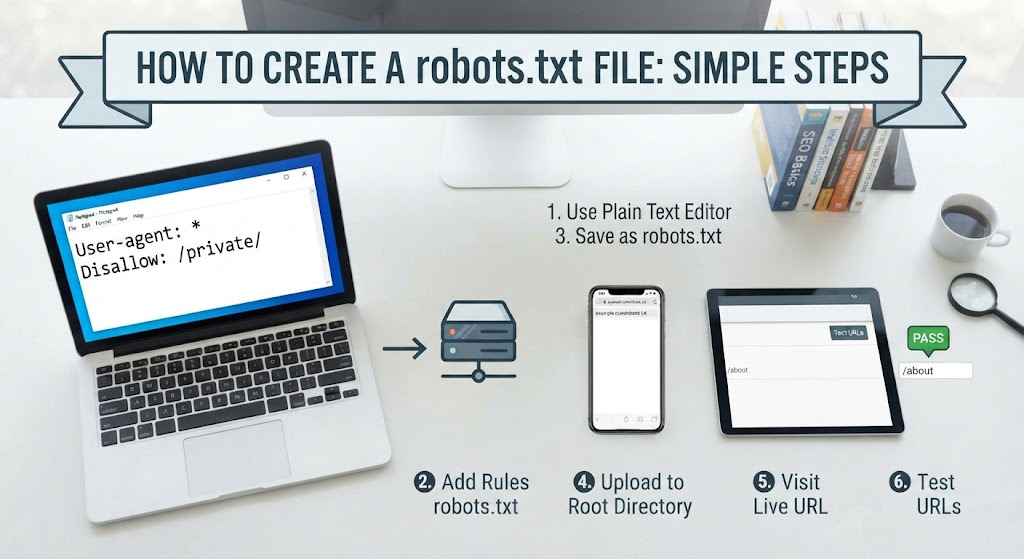
How to Create a robots.txt File
Creating a robots.txt file is simple because it is an ordinary text file.
Follow these steps:
- Open a plain-text editor.
- Create a new file.
- Name it exactly robots.txt.
- Add your crawler rules.
- Save the file as plain text.
- Upload it to your website’s root directory.
- Visit the live /robots.txt URL.
- Test important URLs against your rules.
A simple starting file is:
User-agent: *
Disallow:
Google’s current robots.txt documentation supports fields such as user-agent, allow, and disallow. Google also notes that unsupported fields should not be added simply because another crawler or tool may recognize them.
What Does User-agent Mean?
User-agent identifies the crawler to which a group of rules applies.
For example:
User-agent: *
Disallow:
The * acts as a wildcard for crawlers.
You can also create crawler-specific instructions:
User-agent: Googlebot
Disallow: /private/
But specialized rules require care. A mistake in a crawler-specific group can produce behavior that differs from your general rules.
For most websites, a simple and clearly maintained rule set is easier to manage.
What Does Disallow Mean?
Disallow tells a crawler not to request matching URL paths.
For example:
User-agent: *
Disallow: /admin/
This applies to URLs under the /admin/ path.
You can block a single path:
User-agent: *
Disallow: /example-page/
Or several directories:
User-agent: *
Disallow: /admin/
Disallow: /private/
Disallow: /temporary/
Google provides several examples of directory, page, and pattern-based rules in its official robots.txt documentation.
What Does Allow Mean?
Allow can be used to permit a URL path that would otherwise fall under a broader Disallow rule.
For example:
User-agent: *
Disallow: /private/
Allow: /private/public-page.html
This creates a more specific exception.
Because crawler implementations can differ, always test important URLs after adding complicated Allow and Disallow combinations.
Can Robots.txt Stop Google From Indexing a Page?
No. Robots.txt is not a reliable way to prevent a URL from appearing in Google Search.
This is one of the most important points about robots.txt files uploadarticle.com and general technical SEO.
Google explains that a blocked URL can still potentially appear in search results if Google discovers the URL through other sources. If you need to prevent a page from appearing in Google Search, Google recommends alternatives such as noindex, password protection, or removing the content.
Use the right method
| Your goal | Recommended method |
| Control crawler requests | robots.txt |
| Prevent indexing of an accessible page | noindex |
| Protect confidential content | Authentication/password |
| Remove content completely | Remove the content |
| Help crawlers discover important URLs | XML sitemap |
This distinction prevents many technical SEO mistakes.
Should You Add Your Sitemap to robots.txt?
Yes, adding your XML sitemap location can make sitemap discovery easier for crawlers.
A typical example is:
User-agent: *
Disallow:
Sitemap: https://example.com/sitemap.xml
Bing recommends placing a sitemap reference in the robots.txt file at the root of the host.
The sitemap and robots.txt serve different purposes:
- robots.txt: controls crawler access.
- XML sitemap: helps communicate important URLs.
- Internal links: help search engines discover and understand pages.
- Canonical tags: help indicate preferred versions of duplicate or similar URLs.
Using these tools together creates a clearer crawling setup.
How to Upload robots.txt to Your Website
The exact upload process depends on your hosting setup.
Method 1: Hosting File Manager
If your hosting provider offers a file manager:
- Log in to your hosting account.
- Open the website’s root directory.
- Find the folder containing your main website files.
- Upload robots.txt.
- Confirm the filename is exactly robots.txt.
- Open your domain followed by /robots.txt.
For example:
https://example.com/robots.txt
Method 2: FTP
If you use FTP:
- Connect to your server.
- Open the website’s document root.
- Upload robots.txt.
- Confirm the file permissions allow public access.
- Test the live URL in your browser.
Method 3: CMS
Some content management systems provide their own SEO or search-engine settings.
In that situation, you may not need to manually upload the file. Google notes that some CMS platforms provide their own mechanism for managing robots.txt settings.
How to Test robots.txt Files UploadArticle.com
After uploading robots.txt files uploadarticle.com, never assume the configuration works simply because the file exists.
First, open:
https://yourdomain.com/robots.txt
Check that:
- The file loads successfully.
- The content is readable.
- The rules are spelled correctly.
- Important sections are not accidentally blocked.
- Your sitemap URL is correct if included.
Google recommends checking whether the uploaded file is publicly accessible and can be parsed. Search Console also provides a robots.txt report for accessible robots.txt files.
Bing also provides a robots.txt Tester that can test URLs against your crawler rules.
Common robots.txt Mistakes to Avoid
A small mistake can create a large crawling problem.
1. Blocking the Entire Website
This rule blocks all crawlers:
User-agent: *
Disallow: /
Do not use it on a live website unless completely blocking crawling is your intended result.
2. Blocking Important Content
Avoid rules that accidentally block:
- Blog posts
- Product pages
- Category pages
- Important images
- CSS or JavaScript needed for page rendering
Google warns that blocking important resources can prevent it from properly understanding pages.
3. Using robots.txt for Private Information
Never rely on robots.txt to protect passwords, personal data, private documents, or confidential URLs.
The robots.txt file itself is publicly accessible, and Google warns that disallowed URLs can still potentially be discovered.
4. Writing Unsupported Directives
Do not add random directives copied from unrelated SEO guides.
Google’s specification explains which fields its crawlers support. For Google, crawl-delay is not supported as a robots.txt field.
5. Forgetting the Root Location
A robots.txt file in a random folder does not replace the root robots.txt file for the host.
The expected location is:
https://example.com/robots.txt
Best robots.txt Example for a Normal Website
If you want search engines to crawl your website normally while providing a sitemap location, a simple structure can be:
User-agent: *
Disallow:
Sitemap: https://example.com/sitemap.xml
Replace example.com with your actual domain.
This setup does not block any URL paths. It simply provides a sitemap reference while leaving crawling open.
Advanced robots.txt Example
Suppose you want to prevent crawling of certain low-value areas:
User-agent: *
Disallow: /admin/
Disallow: /private/
Disallow: /search/
Sitemap: https://example.com/sitemap.xml
Before using such a configuration, confirm that those paths really should not be crawled.
Blocking a useful page by mistake can make technical SEO problems harder to diagnose later.
robots.txt vs Noindex: What Is the Difference?
This is a common question when working with robots.txt files uploadarticle.com.
| Feature | robots.txt | noindex |
| Controls crawling | Yes | No |
| Directly requests no indexing | No | Yes |
| Blocks private content securely | No | No |
| Useful for crawl management | Yes | Sometimes |
| Can be placed in page HTML | No | Yes |
| Can be used through HTTP headers | No | Yes, with X-Robots-Tag |
Google’s documentation makes the distinction clear: robots.txt manages crawling, while noindex is an indexing control.
How robots.txt Supports SEO
A well-maintained robots.txt file can support technical SEO by helping crawlers avoid unnecessary areas of a website.
Google recommends using robots.txt to prevent crawling of duplicate or unimportant resources in suitable situations. However, robots.txt should not be changed constantly just to manipulate crawl budget.
A strong technical SEO setup should therefore focus on:
- Valuable, original content
- Clear internal linking
- Clean URL structures
- XML sitemaps
- Correct canonical signals
- Appropriate robots.txt rules
- Fast and accessible pages
- Mobile-friendly pages
- Accurate indexing controls
Robots.txt is one part of the system, not a replacement for overall SEO quality.
robots.txt and AI Crawlers
Modern websites may receive requests from many types of automated crawlers, not only traditional search engine bots.
A robots.txt file can contain rules for specific user agents, but crawler behavior depends on whether the crawler chooses to follow the Robots Exclusion Protocol.
Google describes robots.txt as a standard for communicating crawler preferences, not as an access-control mechanism.
If information must remain private, use authentication or another technical access restriction instead.
How to Troubleshoot a robots.txt Problem
If pages suddenly stop appearing or being crawled, check the following:
Step 1: Open the file
Visit:
https://yourdomain.com/robots.txt
Step 2: Look for broad blocking
Search for:
Disallow: /
A rule like this can block the entire site for the applicable crawler.
Step 3: Check important URLs
Look for rules affecting your:
- Homepage
- Posts
- Categories
- Pages
- Images
- CSS
- JavaScript
Step 4: Check Search Console
Use Google’s available crawling and robots.txt reporting tools to identify potential access problems.
Step 5: Check Bing Webmaster Tools
Bing’s robots.txt Tester can test whether a URL is allowed or blocked by your rules.
Step 6: Review recent changes
If your rankings or crawling changed after editing robots.txt, compare the current file with the previous version.
Best Practices Checklist
Use this checklist before publishing your robots.txt file:
- Filename is exactly robots.txt
- File is located at the root of the host
- File is publicly accessible
- Important pages are not accidentally blocked
- Homepage remains crawlable
- Important resources remain accessible
- Sitemap URL is correct
- No unnecessary directives are included
- Private information is protected with authentication
- Important URLs have been tested
- Search Console has been checked
- Bing Webmaster Tools has been checked when relevant
Frequently Asked Questions
Answer: The phrase refers to robots.txt configuration and upload requirements associated with UploadArticle.com. A robots.txt file normally belongs at the root of the relevant website host and controls crawler access to URL paths.
Answer: It should normally be available at the root of the host, such as https://example.com/robots.txt. Google recommends checking the live URL after uploading the file.
Answer: Robots.txt does not directly guarantee higher rankings. Its main purpose is crawler management, so incorrect rules can actually create crawling problems.
Answer: No. Google states that robots.txt is not a reliable method for preventing a page from appearing in Search. Use noindex, authentication, or content removal when appropriate.
Answer: Adding a sitemap URL can help crawlers discover your sitemap. Bing specifically recommends using a sitemap reference in robots.txt as one way to communicate the sitemap location.
Answer: Open the live /robots.txt URL and test important URLs using available webmaster tools. Google provides robots.txt reporting, while Bing provides a robots.txt Tester.
Conclusion
A properly configured robots.txt file gives search engine crawlers clearer instructions about which parts of a website they can request. For robots.txt files uploadarticle.com, the key is to place the file at the correct root location, use simple rules, protect important pages from accidental blocking, and test every major change.
Do not use robots.txt as a replacement for noindex, security controls, or an XML sitemap. Treat it as one part of your technical SEO setup, and review it whenever your website structure changes.