
A website can have excellent content and still struggle with search discovery when important URLs are difficult for crawlers to find. A sitemap generator by uploadarticle.com can be useful when you need a structured list of website URLs for search engines. The key is not simply creating a sitemap, but creating a clean file containing the right canonical URLs and then submitting it correctly. Google explains that sitemaps help search engines discover URLs, although they do not guarantee crawling, indexing, or rankings.
What Is a Sitemap Generator by UploadArticle.com?
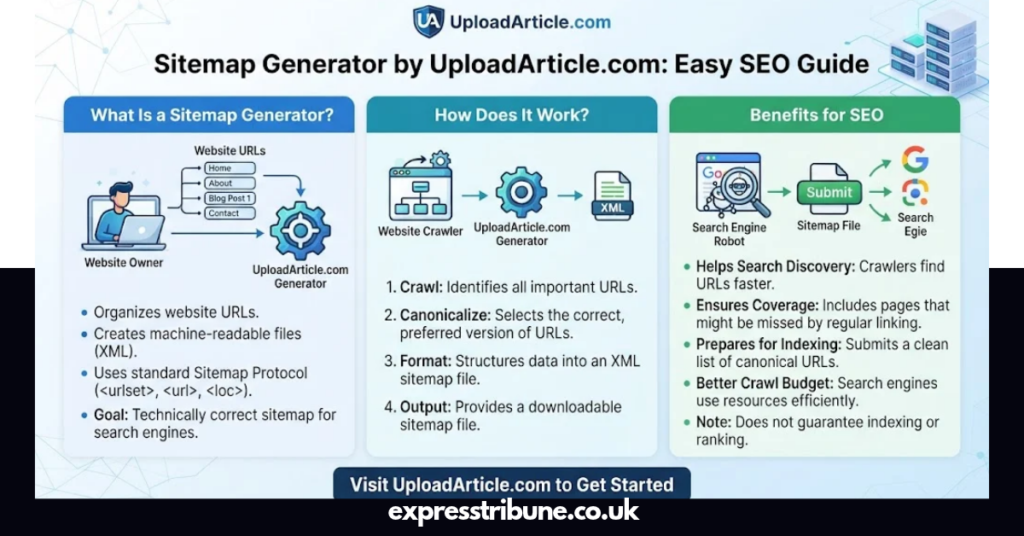
A sitemap generator by uploadarticle.com refers to a sitemap-generation solution associated with UploadArticle.com that can help website owners prepare URLs for sitemap use.
A sitemap generator generally takes website URLs and organizes them into a machine-readable sitemap format. The most common format is XML, which follows the Sitemap Protocol and uses elements such as <urlset>, <url>, and <loc>.
For website owners, the important goal is simple: create a technically correct sitemap that contains the pages you actually want search engines to discover.
How Does a Sitemap Generator Work?
A typical sitemap generator follows a simple process:
- Collects website URLs.
- Removes or avoids unsuitable URLs.
- Organizes the URLs into sitemap format.
- Produces an XML or supported sitemap file.
- Allows the website owner to upload or publish the file.
- The sitemap can then be submitted to search engines.
The exact workflow depends on the generator and website setup. If your website already uses WordPress, Wix, Blogger, or another CMS, check whether the platform automatically creates a sitemap before using another generator. Google notes that many CMS platforms already generate sitemaps automatically.
Why Do You Need a Sitemap?
A sitemap helps search engines discover URLs that may otherwise take longer to find.
This can be especially useful for:
- New websites
- Large websites
- Websites with many categories
- Websites with frequently updated content
- Sites with image, video, or news content
- Websites with pages that are not strongly connected through internal links
Google says a sitemap can be particularly helpful for large or complex websites and newer websites with few external links. However, a sitemap does not guarantee that every submitted URL will be crawled or indexed.
Sitemap Generator by UploadArticle.com vs Manual Creation
Creating a sitemap manually is possible, but it becomes inconvenient as a website grows.
| Method | Best For | Main Benefit | Main Limitation |
| Manual sitemap | Small sites | Full control | Time-consuming |
| CMS sitemap | WordPress and similar sites | Automatic updates | Depends on CMS |
| Sitemap generator | Custom websites | Faster URL organization | Requires URL checking |
| Sitemap index | Large websites | Manages multiple sitemap files | More technical |
| Text sitemap | Simple URL lists | Very easy structure | Limited compared with XML |
Google supports XML, RSS, Atom, and text sitemap formats. XML is the most versatile option because it can provide additional information for certain content types.
What URLs Should You Put in a Sitemap?
The quality of your sitemap depends heavily on the URLs you include.
A good sitemap should generally contain:
- Important published pages
- Canonical URLs
- Main category pages
- Useful blog posts
- Product pages
- Important service pages
- Pages you want search engines to discover
Avoid filling your sitemap with URLs that you do not want appearing in search results.
For example, you normally should review URLs such as:
- Duplicate pages
- Temporary URLs
- Filter combinations
- Internal search pages
- URLs blocked from crawling
- Redirecting URLs
- Pages marked noindex
- Thin or unnecessary pages
Google recommends including the URLs you want to appear in search results and using canonical URLs when multiple URLs represent similar content.
How to Create an XML Sitemap
Creating an XML sitemap becomes easier when you understand its basic structure.
A simple sitemap looks like this:
<?xml version=”1.0″ encoding=”UTF-8″?>
<urlset xmlns=”http://www.sitemaps.org/schemas/sitemap/0.9″>
<url>
<loc>https://example.com/</loc>
</url>
<url>
<loc>https://example.com/about/</loc>
</url>
<url>
<loc>https://example.com/blog/</loc>
</url>
</urlset>
The Sitemap Protocol requires the XML file to use UTF-8 encoding. Each URL entry uses a <url> element, while <loc> identifies the URL.
A generator saves you from manually building this structure when you have hundreds or thousands of URLs.
Sitemap Size Limits You Should Know
Large websites need to pay attention to sitemap limits.
According to Google’s current documentation, a single sitemap can contain up to 50,000 URLs or 50 MB when uncompressed, whichever limit is reached first. Larger websites should divide their URLs into multiple sitemap files and use a sitemap index when appropriate.
| Sitemap Requirement | Limit or Recommendation |
| URLs per sitemap | Up to 50,000 |
| Uncompressed sitemap size | Up to 50 MB |
| Encoding | UTF-8 |
| URL format | Absolute URLs |
| Large website | Use multiple sitemaps |
| Multiple sitemaps | Use a sitemap index |
| Preferred location | Often site root |
This makes sitemap organization important for ecommerce stores, publishers, directories, and large content websites.
How to Submit Your Sitemap to Google
After generating your sitemap, the next step is making Google aware of it.
You can submit the sitemap through Google Search Console. For websites with many URLs, Google specifically recommends submitting a sitemap as a way to help Google discover those URLs.
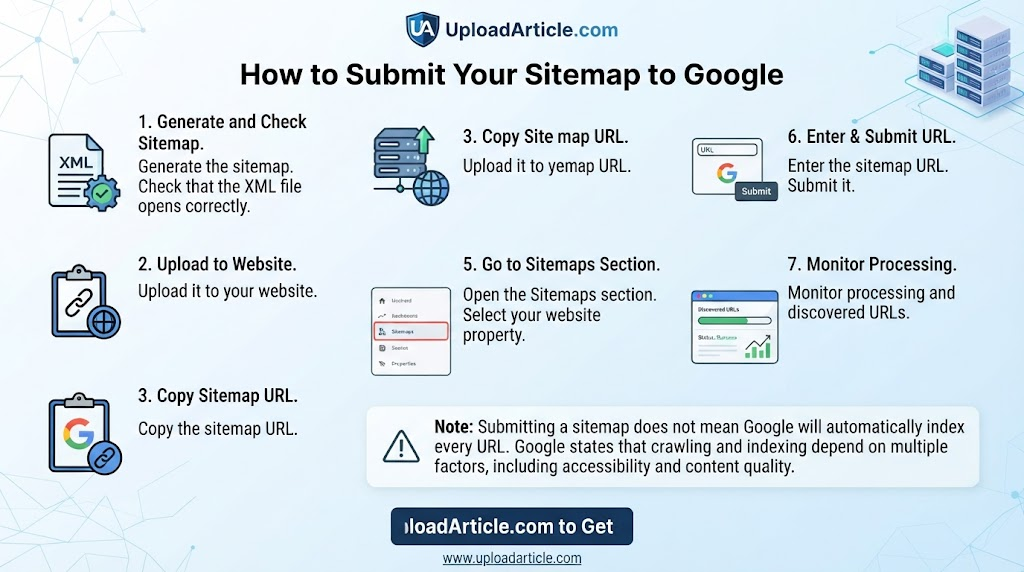
A basic workflow is:
- Generate the sitemap.
- Check that the XML file opens correctly.
- Upload it to your website.
- Copy the sitemap URL.
- Open Google Search Console.
- Select your website property.
- Open the Sitemaps section.
- Enter the sitemap URL.
- Submit it.
- Monitor processing and discovered URLs.
Submitting a sitemap does not mean Google will automatically index every URL. Google states that crawling and indexing depend on multiple factors, including accessibility and content quality.
Can a Sitemap Improve Google Rankings?
A sitemap is primarily a discovery and crawling aid, not a direct ranking shortcut.
This distinction matters because website owners sometimes expect a sitemap submission to immediately increase rankings. Google states that a sitemap can help it learn about URLs but does not guarantee indexing or increase a site’s ranking by itself.
A strong SEO setup should therefore combine:
- Helpful content
- Clear internal links
- Crawlable pages
- Correct canonical URLs
- Fast and accessible pages
- A clean sitemap
- Appropriate robots.txt rules
- Strong technical SEO
The sitemap supports the system; it does not replace good SEO.
Sitemap Generator by UploadArticle.com for New Websites
New websites can benefit from a properly prepared sitemap because search engines may not immediately discover every new URL through external links.
Google explains that new websites with few external links can have more difficulty getting pages discovered. A sitemap gives Google another way to learn about the URLs that exist on the site.
For a new website, create a simple sitemap containing your most important pages first:
- Homepage
- About page
- Contact page
- Main service pages
- Important categories
- High-value articles
- Product pages
Then keep the sitemap updated as the website grows.
Sitemap Generator by UploadArticle.com for Large Websites
Large websites face a different challenge: URL management.
A site with thousands of pages can contain old URLs, duplicate variations, redirects, deleted pages, category archives, and other technical clutter. A generator can make the initial sitemap creation easier, but you still need to review the URLs before submission.
If your site exceeds the normal sitemap limits, divide the URLs across multiple sitemap files and create a sitemap index. Google and the Sitemap Protocol both support this structure.
How to Check Whether Your Sitemap Is Correct
Before submitting your sitemap, perform a basic technical check.
1. Open the sitemap URL
Make sure the file loads publicly without requiring a login.
2. Check the URLs
Confirm that the listed URLs belong to your website and use the correct HTTPS version.
3. Check redirects
Avoid using redirected URLs when the final destination can be listed instead.
4. Check canonical pages
Your sitemap should generally focus on the URLs you consider canonical and want indexed. Google recommends using canonical URLs in sitemaps.
5. Check robots.txt
Make sure your important pages are not accidentally blocked from crawling.
6. Check Search Console
After submission, monitor sitemap processing and indexing information in Google Search Console.
Sitemap and Robots.txt: What Is the Difference?
A sitemap and robots.txt file have different jobs.
| Feature | Sitemap | Robots.txt |
| Main purpose | Help discover URLs | Control crawler access |
| Lists URLs | Yes | No |
| Tells crawlers about important URLs | Yes | No |
| Controls crawling | No | Yes |
| Can reference the other | Yes, indirectly through robots.txt | Yes, can contain sitemap location |
| Replaces the other | No | No |
Bing’s official documentation explains that you can reference a sitemap from robots.txt using a Sitemap: directive.
For example:
Sitemap: https://example.com/sitemap.xml
This creates another discovery path for crawlers.
How Bing Uses Sitemaps
Bing Webmaster Tools supports XML sitemaps, sitemap index files, RSS, Atom, and text sitemap formats.
You can submit a sitemap through Bing Webmaster Tools and monitor information such as processing status and discovered URLs.
Bing also provides sitemap-related reporting that can help website owners identify processing issues and understand which URLs were discovered.
For websites targeting both Google and Bing, maintaining one clean sitemap structure can simplify technical SEO management.
Common Sitemap Mistakes to Avoid
A sitemap can create problems when it contains poor-quality or incorrect URL data.
Avoid these common mistakes:
- Adding URLs that return 404 errors
- Listing redirected URLs
- Adding duplicate URL variations
- Using HTTP when the site uses HTTPS
- Using relative URLs
- Including URLs you do not want indexed
- Accidentally blocking sitemap access
- Forgetting to update manually created sitemaps
- Exceeding sitemap size limits
- Assuming submission guarantees indexing
Google recommends fully qualified absolute URLs in sitemaps rather than relative paths.
Best Practices for Sitemap SEO
For a clean and useful sitemap, follow these practices:
Keep It Focused
List important URLs rather than every URL your website can generate.
Use Canonical URLs
If several URLs show similar content, identify the preferred canonical URL and use that in your sitemap.
Keep It Updated
New content should eventually appear in your sitemap, while permanently removed URLs should not remain there.
Use HTTPS
If your website uses HTTPS, list the HTTPS version of your pages.
Use Absolute URLs
Write the complete URL instead of a relative path.
Split Large Sitemaps
Use multiple sitemap files when your website reaches the size limits.
Monitor Errors
Check Google Search Console and Bing Webmaster Tools after submission.
These practices make the sitemap more useful for both website owners and search engine crawlers.
Sitemap Generator by UploadArticle.com: Quick Comparison Table
| Question | Short Answer | Recommended Action |
| What is a sitemap? | A structured list of URLs | Keep important URLs organized |
| Why use one? | It helps URL discovery | Submit it to search engines |
| Best common format? | XML | Use XML for broad flexibility |
| How many URLs? | Up to 50,000 per sitemap | Split larger sites |
| Maximum file size? | 50 MB uncompressed | Create multiple files if needed |
| Does it guarantee indexing? | No | Improve content and technical SEO too |
| Should redirects be included? | Usually no | List the final canonical URL |
| Should duplicate URLs be included? | No | Use preferred canonical URLs |
| Where should it go? | Often the root | Example: /sitemap.xml |
| Can robots.txt reference it? | Yes | Add a Sitemap directive |
| Can Bing use it? | Yes | Submit through Bing Webmaster Tools |
| Can Google use it? | Yes | Submit through Search Console |
Who Should Use a Sitemap Generator?
A sitemap generator can be useful for:
- Bloggers
- Small businesses
- Ecommerce websites
- News websites
- Affiliate websites
- SaaS websites
- Agencies
- Publishers
- Large content websites
- Custom-coded websites
However, not every website needs a third-party generator. If your CMS already creates and updates a reliable sitemap, using that built-in system may be simpler.
Google specifically notes that many CMS platforms automatically generate sitemaps.
Does a Sitemap Guarantee Indexing?
No. A sitemap does not guarantee indexing.
A sitemap helps search engines discover URLs, but Google decides whether and when to crawl, index, and display pages. Content quality, accessibility, internal linking, canonicalization, technical issues, and many other signals can affect the process.
Think of a sitemap as a clear map of your website. It helps search engines understand which URLs you want them to discover, but it does not force those URLs into search results.
How to Get More Value From Your Sitemap
The best results come from combining the sitemap with a clean website structure.
Use this checklist:
- Create useful pages.
- Link important pages internally.
- Use descriptive URLs.
- Set correct canonical URLs.
- Keep important pages crawlable.
- Avoid unnecessary duplicate URLs.
- Maintain your sitemap.
- Submit it to Google Search Console.
- Submit it to Bing Webmaster Tools.
- Monitor indexing reports.
- Fix sitemap errors quickly.
Google explains that internal links are an important way for Googlebot to discover pages, while sitemaps provide another discovery mechanism.
Frequently Asked Questions
A sitemap generator by UploadArticle.com refers to a sitemap-generation solution associated with UploadArticle.com. Sitemap generators generally organize website URLs into a format that search engines can process.
Yes, it can support technical SEO by helping search engines discover important URLs. However, a sitemap alone does not improve rankings or guarantee indexing.
A single sitemap can contain up to 50,000 URLs and must not exceed 50 MB when uncompressed. Larger websites can use multiple sitemap files and a sitemap index.
Yes, submitting a sitemap through Google Search Console is a useful way to tell Google about your site’s URLs, especially when your website contains many pages or has recently launched.
Yes. You can reference the sitemap location in robots.txt with a Sitemap: directive. Bing’s official documentation supports this approach.
No. A sitemap helps with URL discovery but does not guarantee crawling, indexing, or ranking. Google explicitly states that sitemap submission does not guarantee indexing or increase rankings by itself.
Conclusion
A well-built sitemap gives search engines a clear list of the pages that matter on your website. A sitemap generator by uploadarticle.com can be part of that workflow, but the real SEO value comes from using accurate URLs, maintaining canonical pages, keeping the sitemap updated, and monitoring how search engines process it.
If your website has many pages, start by cleaning your URL structure and creating a focused sitemap. Then submit it through Google Search Console and Bing Webmaster Tools, monitor errors, and keep improving the pages you want search engines and users to find.