
Finding a useful publishing blog can be difficult when many websites use similar names and cover overlapping topics. The blog BlueFlamePublishing attracts interest because it presents itself as a digital space for writers, readers, creativity, publishing, and online content. The important question is what the platform actually offers and how readers should understand its purpose. This guide explains its visible focus, content types, audience, publishing approach, and practical value without confusing it with similarly named websites.
What Is the Blog BlueFlamePublishing?
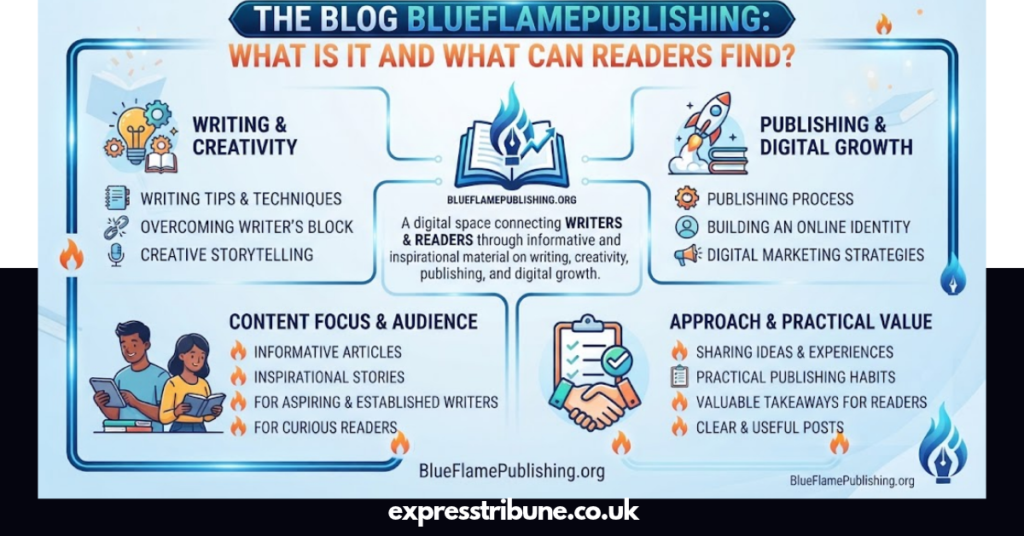
The blog BlueFlamePublishing refers to a digital publishing and blogging platform that presents content around writing, creativity, publishing, digital growth, and related subjects.
The official BlueFlamePublishing.org About page describes the platform as a space connecting writers and readers. It says the site aims to publish informative and inspirational material while giving writers a place to share ideas and stories.
Its published material also covers broader digital subjects. The site’s recent posts include articles about blogging, online identity, marketing, technology, and publishing.
Quick Overview
| Element | What readers can expect |
| Platform type | Digital publishing and blogging website |
| Main audience | Readers, writers, bloggers, and creators |
| Core themes | Writing, publishing, creativity, digital content |
| Content style | Informational and educational articles |
| Publishing focus | Articles, ideas, writing guidance, and digital topics |
| Reader benefit | Discovering ideas and learning about content creation |
| Writer benefit | Exploring publishing and online writing concepts |
| SEO relevance | Clear topics, useful answers, and structured information |
The key point is simple: the platform should be viewed through the content it actually publishes rather than through its name alone.
What Does BlueFlamePublishing Focus On?
The stated mission of BlueFlamePublishing.org centers on writing, reading, creativity, and connecting writers with readers. Its About page also describes a team involving writers, editors, designers, and marketers.
Published articles show that the site’s subject range can extend beyond traditional publishing. Readers may encounter content related to blogging, digital growth, online identity, creativity, and other informational subjects.
This makes the site more of a broad digital-content platform than a website dedicated only to traditional book publishing.
What Can You Find on the Blog?
The blog BlueFlamePublishing contains different types of articles, so visitors should not expect every page to follow one narrow format.
Common content themes include:
- Blogging and content creation
- Writing and publishing
- Digital identity
- Creativity and storytelling
- Online growth
- Marketing concepts
- Technology-related subjects
- Guidance for writers and creators
The site’s recent homepage listings show articles covering blogging identities, marketing, publishing, and digital growth.
This variety can help readers explore different subjects, but it also means that visitors should check the individual article’s author, sources, date, and topic before relying on specific claims.
Is BlueFlamePublishing the Same as Every Site Using the Name?
No assumption should be made that every website containing the words Blue Flame Publishing belongs to the same organization.
Search results currently show multiple similarly named domains, including BlueFlamePublishing.org, BlueFlamePublishing.net, BlueFlamePublishing.blog, and BlueFlamePublishingBlog.com.
That distinction matters.
A reader researching the blog BlueFlamePublishing should check:
- The exact domain name.
- The site’s About page.
- The author name.
- The publication date.
- Contact information.
- Whether the article provides sources.
- Whether the site’s stated ownership matches the information being discussed.
This simple check prevents information from different websites being combined accidentally.
What Is the Main Audience?
The platform appears to target people who have an interest in writing, reading, blogging, publishing, and digital content.
Writers
New and independent writers can use publishing-focused articles to learn about content development, online publishing, audience building, and digital identity.
Readers
Readers can explore articles covering creative and informational subjects without limiting themselves to one narrow category.
Bloggers
Bloggers can find ideas related to content creation, blogging strategy, and building an online presence.
Digital Creators
Creators who work with online content can use publishing and marketing discussions as starting points for their own research.
The best value comes when visitors use individual articles for a clear purpose rather than treating the entire site as an authority on every subject.
How Does the Blog Help Writers?
Writing a good article is only one part of building an online presence. A writer also needs to understand audience needs, structure, editing, publishing, and presentation.
The blog BlueFlamePublishing presents itself as a place where writers can explore these wider ideas.
For a beginner, useful lessons include:
- Choosing a clear topic.
- Understanding the intended reader.
- Creating an informative headline.
- Organizing information with headings.
- Editing unnecessary sentences.
- Supporting factual claims with reliable sources.
- Building a consistent publishing habit.
- Developing a recognizable writing style.
These principles can help a writer turn an idea into content that readers can actually use.
Why Is Content Structure Important?
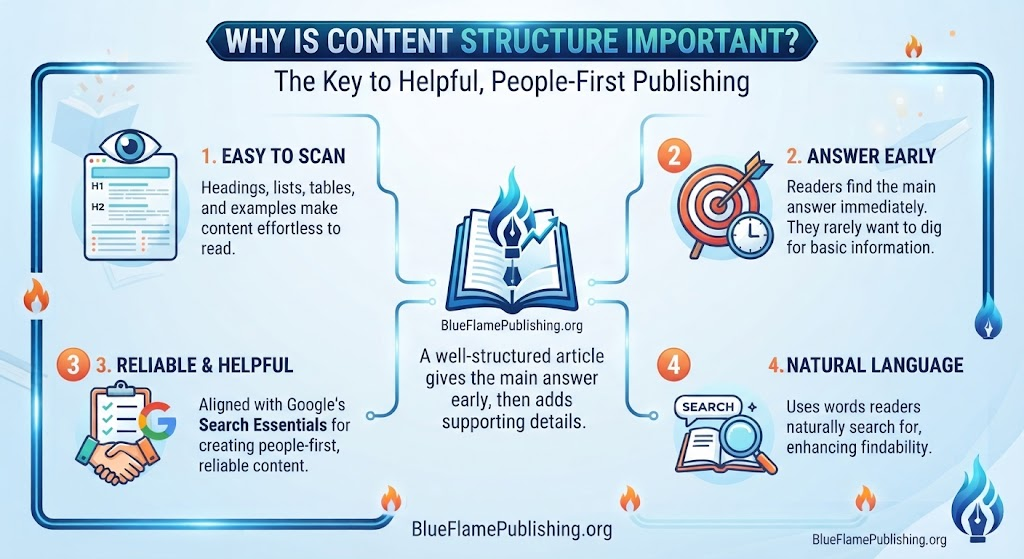
Readers rarely want to work hard to find a basic answer.
A strong article gives the main answer early, then adds supporting details. Headings, short paragraphs, lists, tables, and examples make longer content easier to scan.
Google’s Search Essentials recommends creating helpful, reliable, people-first content and using words that readers would naturally use when searching for information.
For that reason, a well-structured publishing article should answer the central question before moving into secondary information.
How Can Readers Evaluate an Article?
Not every online article deserves the same level of trust.
Before accepting an important claim, readers should consider the following:
| Check | Why it matters |
| Author | Shows who created the information |
| Date | Helps identify outdated material |
| Sources | Makes factual claims easier to verify |
| About page | Provides information about the publisher |
| Contact details | Adds transparency |
| Topic expertise | Helps establish subject knowledge |
| Originality | Reduces the risk of copied information |
| Evidence | Makes important claims easier to assess |
Google’s people-first guidance specifically recommends clear authorship, background information, trustworthy sourcing, and demonstrable expertise where appropriate.
That approach is useful when evaluating the blog BlueFlamePublishing or any other publishing website.
What Does Mean for BlueFlamePublishing Content?
E-E-A-T stands for Experience, Expertise, Authoritativeness, and Trustworthiness.
Google explains that E-E-A-T is not itself a single ranking factor. Instead, it describes qualities that can help search systems identify useful and trustworthy content. Google also says trust is the most important part of the concept.
For a publishing website, practical trust signals include:
- Accurate author biographies.
- Clear editorial information.
- Reliable citations.
- Updated factual information.
- Original analysis.
- Transparent corrections.
- Relevant first-hand experience.
- Clear ownership and contact information.
A page does not become trustworthy simply because it uses an impressive title or contains many keywords.
How Does SEO Fit Into the Blog?
SEO can help readers discover useful content, but SEO should support the article rather than control it.
Google’s current guidance recommends people-first content and warns against creating large quantities of pages mainly to attract search traffic. It also states that there is no preferred word count that automatically makes a page rank.
For a publishing blog, useful SEO practices include:
- Write a descriptive title.
- Answer the main question clearly.
- Use meaningful headings.
- Keep paragraphs easy to read.
- Add relevant internal links.
- Cite reliable sources.
- Use descriptive image alt text.
- Keep important pages crawlable.
- Make the site mobile-friendly.
- Avoid repetitive keyword placement.
The goal should be a satisfying reading experience, not a page written only for search engines.
Can the Blog BlueFlamePublishing Appear in Google AI Features?
A useful article can be eligible to appear as a supporting result in Google’s AI features when it meets the normal requirements for Google Search.
Google says there are no additional technical requirements specifically for AI Overviews or AI Mode beyond being indexed and eligible for Search. It recommends the same foundational SEO practices: helpful content, clear technical structure, and unique information that provides real value.
Google also advises publishers to create original, non-commodity content rather than simply repeating information already available elsewhere.
For the blog BlueFlamePublishing, this means an article should offer something useful beyond changing the wording of another website’s content.
What Makes a BlueFlamePublishing Article More Useful?
A useful article should solve a real reader problem.
For example, instead of writing several paragraphs saying that blogging is important, a stronger article could explain:
- How to choose a blog topic.
- How to identify a target reader.
- How to structure a post.
- How to research claims.
- How to edit an article.
- How to add useful examples.
- How to measure reader engagement.
- How to update outdated information.
This approach gives readers practical information they can use after leaving the page.
What Should Writers Avoid?
A publishing website can lose value when articles focus more on search traffic than reader needs.
Writers should avoid:
- Repeating the same keyword in every paragraph.
- Copying another article’s structure too closely.
- Making unsupported claims.
- Creating pages with little original information.
- Using exaggerated headlines.
- Publishing unrelated topics only because they appear popular.
- Adding unnecessary sections simply to increase length.
- Hiding important information behind vague introductions.
Google’s current guidance specifically warns against search-engine-first content, mass-produced pages created primarily for traffic, and content that merely summarizes existing material without adding meaningful value.
The Difference Between Publishing and Simply Posting
Publishing involves more than pressing a publish button.
A professional publishing process can include:
Research → Writing → Editing → Fact-checking → Formatting → Publishing → Promotion → Updating
Each step improves the final experience.
Research helps prevent errors. Editing improves clarity. Fact-checking protects trust. Formatting makes information easier to consume, while updates help keep useful pages accurate.
This process is especially important when a website covers subjects that can change over time.
How Should You Research BlueFlamePublishing?
If someone wants to learn more about the blog BlueFlamePublishing, the safest approach is to start with first-party information.
Check the site’s:
- Homepage.
- About page.
- Author pages.
- Contact information.
- Recent posts.
- Editorial information.
- Privacy and site policies.
The BlueFlamePublishing.org About page provides information about its stated mission, team, writers, and relationship between readers and creators.
For SEO-related questions, Google’s own Search Central documentation is the better source for Google’s policies and recommendations rather than relying on third-party SEO claims.
Is the Blog Useful for New Writers?
It can be useful as a starting point for people who want to explore blogging, writing, publishing, and digital content.
However, new writers should combine blog articles with direct experience and authoritative sources. A publishing blog can introduce an idea, but writers should research important technical, legal, medical, financial, or other high-impact claims through appropriate primary or professional sources.
This creates a healthier research process:
Discover → Verify → Understand → Apply → Review
That method is more valuable than simply collecting articles.
A Simple Content Strategy Inspired by Publishing Best Practices
Writers who want to build a useful blog can follow this basic framework:
| Stage | Action | Reader benefit |
| 1 | Select one clear topic | Removes confusion |
| 2 | Identify the reader | Improves relevance |
| 3 | Research primary sources | Builds trust |
| 4 | Create a direct answer | Helps readers quickly |
| 5 | Add supporting details | Provides depth |
| 6 | Use examples | Makes ideas easier |
| 7 | Edit the draft | Improves clarity |
| 8 | Add useful links | Supports further research |
| 9 | Check facts | Reduces errors |
| 10 | Update when needed | Keeps information useful |
Google’s Search Central guidance supports this people-first approach and emphasizes original, useful, reliable information rather than content produced mainly to manipulate rankings.
Frequently Asked Questions
The blog BlueFlamePublishing is a digital publishing and blogging platform associated with writing, creativity, readers, writers, and online content. The BlueFlamePublishing.org About page describes its purpose as connecting writers and readers through published content.
The available content includes writing, publishing, blogging, creativity, digital identity, marketing, and other online subjects. The exact topics vary between articles and over time.
Not necessarily. Search results show several similarly named websites, including BlueFlamePublishing.org and BlueFlamePublishingBlog.com. Readers should check each site’s ownership and About information instead of assuming that all domains represent one organization.
Yes. Articles about blogging, writing, publishing, and digital content can provide ideas for writers and creators. Readers should still verify important claims through appropriate primary or professional sources.
No. Google says there is no preferred word count that automatically helps a page rank. The priority is useful, complete, people-first information that satisfies the reader’s need.
Pages that are indexed and eligible for Google Search can potentially appear as supporting links in AI features. Google says there are no separate technical requirements specifically for AI Overviews, but helpful, reliable, original content and solid SEO foundations remain important.
Conclusion
The blog BlueFlamePublishing can be understood as part of a broader online publishing and content ecosystem centered on writing, creativity, blogging, and digital information. Its public material shows an interest in connecting writers and readers while covering a range of publishing and online-content subjects.
The most important lesson for readers and writers is to look beyond the name. Check the exact domain, identify the author, examine sources, compare important claims, and use first-party information whenever possible.