
Finding useful information online can be difficult when every topic leads to a different website. Vocal News Media brings a wide mix of subjects into one publishing platform, from business and technology to health, education, entertainment, finance, and lifestyle. The site also publishes guides, explainers, reviews, and informational articles. This guide explains what Vocal News Media is, what readers can find there, how its categories work, and what to check when evaluating online content.
What Is Vocal News Media?
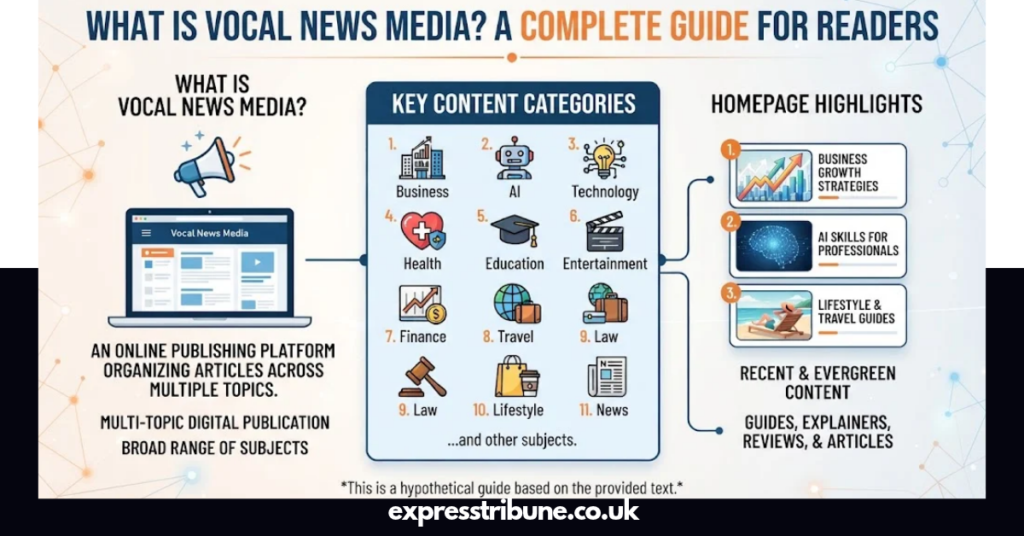
Vocal News Media is an online publishing website that organizes articles across multiple categories. Its current website includes sections covering business, AI, technology, health, education, entertainment, finance, travel, law, lifestyle, news, and other subjects.
The site’s homepage currently highlights recent articles alongside older evergreen content. Recent examples include articles about business growth, AI skills, literature, lifestyle, and technology-related subjects.
This broad structure makes Vocal News Media more like a multi-topic digital publication than a website focused on only one subject.
What Does Vocal News Media Cover?
The biggest feature of Vocal News Media is its range of topics. Readers can move between practical guides, informational articles, news-related posts, and general-interest content.
Current categories listed on the site include:
| Category | What Readers May Find |
| Business | Business guides, customer service, workplace topics |
| Technology | AI, cloud hosting, digital tools, technology guides |
| AI | Artificial intelligence skills and educational content |
| Health | Wellness, health information, personal care topics |
| Education | Learning resources and academic subjects |
| Finance | Money, financial concepts, and related guides |
| Crypto | Cryptocurrency and digital-asset topics |
| Entertainment | Entertainment stories and popular-interest content |
| Lifestyle | Relationships, daily living, and lifestyle subjects |
| Travel | Travel-related guides and information |
| Law | Legal information and general legal topics |
| Home | Home improvement, maintenance, and property subjects |
| Fashion | Fashion and personal-style content |
| Automobile | Automotive information and guides |
| Real Estate | Property and real-estate topics |
The category structure shows that Vocal News Media aims to serve readers with different interests instead of limiting its publishing scope to one niche.
What Kind of Articles Can You Find?
Vocal News Media publishes several different content formats. These include practical guides, educational articles, general information, business content, technology explainers, lifestyle pieces, and news-related posts.
For example, its current homepage features an article about SoSoActive and digital growth, an educational summary of The Fun They Had, an AI skills article, and lifestyle content.
This variety can help readers who prefer having several information categories available from one website.
Is Vocal News Media a News Website or a General Blog?
A better description is a multi-topic online publication.
The site has a dedicated News category, but its overall content library is much broader. It also has separate categories for Business, Technology, Health, Entertainment, Education, AI, Finance, Home, Travel, and other subjects.
That distinction matters because readers should not assume every article on a multi-topic publication is breaking news. Some pages are evergreen guides, educational resources, reviews, or general-interest articles.
What Are the Main Strengths of Vocal News Media?
The main advantage of Vocal News Media is topic variety. Readers can explore different subjects without restricting themselves to one narrow category.
Other useful features include:
- Multiple content categories
- Regularly updated homepage sections
- Articles with visible author names
- Business and technology coverage
- AI and education content
- Health and lifestyle information
- News and current-interest articles
- Search-friendly category organization
- Both newer and evergreen articles
The site currently displays author names and publication dates on many articles. That information gives readers useful context when deciding how recent a piece is.
How Can Readers Check the Quality of an Article?
A website name alone should not determine whether you trust a particular article. Readers should evaluate the individual page, especially when the topic involves health, finance, law, safety, or other areas where inaccurate information can cause problems.
Before relying on an article, check:
- Author — Look for a clearly identified writer.
- Publication date — Check when the article was published or updated.
- Sources — Look for links to official or authoritative references.
- Evidence — See whether important claims have supporting information.
- Specificity — Prefer useful details over vague statements.
- Context — Check whether the article explains limits or exceptions.
- Freshness — Make sure the information still applies.
Google’s own guidance emphasizes creating helpful, reliable, people-first content rather than content made mainly to manipulate search rankings.
Why Do Author Names and Dates Matter?
Author names and dates help readers understand where information comes from and how current it may be.
The current Vocal News Media site displays bylines such as Shivi Hyde and Devin Haney across its articles. Its homepage also shows publication dates for recent posts.
For fast-changing topics such as AI, technology, finance, and online services, dates are especially useful. A guide published several years ago may still contain useful background information, but readers should verify details that can change quickly.
How Does Vocal News Media Organize Its Content?
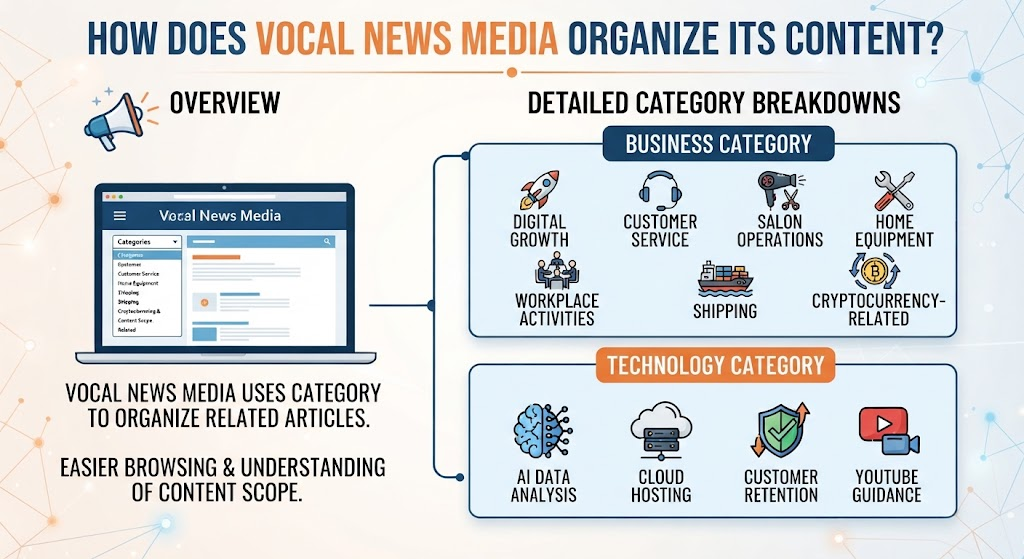
Vocal News Media uses category pages to organize related articles. This makes it easier for visitors to browse a subject instead of searching through the entire website.
For example, the Business category currently contains articles about digital growth, customer service, salon operations, home equipment, workplace activities, shipping, and cryptocurrency-related topics.
The Technology category includes topics such as AI data analysis, cloud hosting, customer retention, and YouTube-related guidance.
This category-based structure also helps readers understand the publication’s overall content scope.
Is Vocal News Media Useful for Business and Technology Readers?
Yes, the site has a noticeable amount of business and technology content.
Business readers can find articles covering workplace practices, customer service, digital growth, shipping, and other commercial subjects. Technology readers can explore AI, cloud services, digital tools, and related topics.
The value of an individual article still depends on its accuracy, depth, sourcing, and freshness. Readers should assess those factors page by page rather than assuming every article has the same level of authority.
What Should Readers Know About Health and Finance Articles?
Health and finance topics require extra care. Vocal News Media has dedicated categories for both areas, but readers should distinguish general educational information from professional advice.
For health questions, use reliable medical organizations and qualified healthcare professionals for diagnosis or treatment decisions. For financial decisions, verify important information through regulators, financial institutions, official filings, or qualified professionals.
A useful article can help explain a topic, but it should not replace professional advice when the decision carries significant personal or financial consequences.
How Does Vocal News Media Support Different Search Intents?
A useful publication should answer different types of search questions instead of repeating the same information.
Vocal News Media contains several formats that match common search intents:
| Search Intent | Suitable Content Type |
| Informational | Explainers and educational guides |
| How-to | Step-by-step articles |
| Commercial research | Comparisons and product/service information |
| News discovery | News and current-interest articles |
| Topic research | Long-form guides |
| Definition | Simple explanatory content |
| Academic | Literature and education articles |
| Business research | Business and technology guides |
This structure can make the site useful for readers who enter very different searches.
Can Vocal News Media Appear in Google Search and AI Features?
A website can be eligible for Google Search features when its pages meet Google’s technical and content requirements, but no publisher can guarantee a particular ranking or AI Overview placement.
Google’s current documentation says its AI features use web sources and that existing SEO best practices remain relevant. Google also provides guidance for publishers about appearing in AI Overviews and AI Mode.
For Vocal News Media, this means useful content should focus on answering real reader questions clearly, supporting important claims, maintaining accessible pages, and keeping information accurate.
What SEO Practices Can Help Vocal News Media?
Strong SEO should support readers first. Important areas include:
- Clear page titles
- Descriptive headings
- Helpful introductions
- Logical internal linking
- Descriptive URLs
- Original information
- Accurate author information
- Useful images with appropriate descriptions
- Fast and mobile-friendly pages
- Clear source attribution
- Updated information
- Structured data where appropriate
Google says structured data can help its systems understand page content and supports several search features, including Article and Organization markup.
Google also recommends considering the overall page experience, including mobile usability, secure delivery, Core Web Vitals, and avoiding intrusive elements that interfere with the main content.
How Can Vocal News Media Improve Trust and E-E-A-T?
For Vocal News Media, trust can grow when each article makes it easy for readers to understand who wrote it, when it was published, what evidence supports it, and where additional information can be verified.
A strong editorial page can include:
- A clear author byline
- An author profile when appropriate
- Publication and update dates
- Primary source links
- Editorial standards
- Corrections information
- Contact information
- Clear advertising or sponsored-content disclosures
- Original reporting where available
- Expert review for specialized subjects
Google’s documentation does not provide a numerical E-E-A-T score that publishers can achieve. Instead, publishers should focus on demonstrating experience, expertise, authoritativeness, and trust through the quality and transparency of their content.
What Makes Content Helpful for AI Search?
AI-powered search changes how people discover information, but the basic goal remains simple: answer the reader’s question well.
For Vocal News Media, useful AI-search content should:
- Answer the main question early.
- Explain important details in plain language.
- Use descriptive H2 and H3 headings.
- Include facts that can be verified.
- Add original examples or analysis.
- Avoid unnecessary repetition.
- Cover related questions naturally.
- Keep important information easy to find.
- Update time-sensitive information.
Google’s 2026 Search documentation specifically discusses optimization for generative AI features and notes that traditional SEO fundamentals continue to matter for Google’s generative search experiences.
How Should Readers Use Vocal News Media Effectively?
The easiest approach is to start with the category that matches your question.
For example:
For technology: Start with Technology or AI.
For business: Browse Business and related digital-growth topics.
For health: Use Health for general educational reading, then verify important medical information with authoritative sources.
For education: Explore Education and Literature.
For lifestyle: Browse Lifestyle, Home, Fashion, and Relationship content.
For current topics: Check the publication date before relying on information.
This approach helps readers find relevant information faster and avoid treating every article as the same type of content.
Vocal News Media Content Overview
The following table gives a simple snapshot of how readers can approach the website:
| Feature | What It Means for Readers |
| Multi-topic publication | One site covers many subjects |
| Category navigation | Related articles are grouped together |
| Author bylines | Readers can identify the listed writer |
| Publication dates | Readers can judge content freshness |
| Business coverage | Useful for commercial and workplace topics |
| Technology coverage | Includes AI and digital subjects |
| Health section | Provides general health-related reading |
| Education section | Includes learning and literature topics |
| News section | Contains news-focused articles |
| Lifestyle content | Covers everyday interests |
| Search-focused structure | Categories help users discover related pages |
| Mixed evergreen content | Older guides may remain useful after publication |
What Should Publishers Learn From Vocal News Media?
Other publishers can take several practical lessons from the site’s multi-category structure.
First, a large website needs clear organization. Categories help readers understand what a publication covers and make related content easier to discover.
Second, each article needs its own value. Publishing across many topics does not automatically create authority. A useful page should answer a real question, provide accurate information, and give readers enough detail to act on the information.
Third, transparency matters. Visible authors, dates, sources, and editorial information can make a publication easier for readers to evaluate.
Vocal News Media and People-First SEO
The strongest SEO strategy is not simply repeating a keyword a certain number of times. Google evaluates many signals and systems, and Google itself advises publishers to create content primarily to help people rather than to manipulate rankings.
That is important for Vocal News Media because a multi-topic website can easily become repetitive if it publishes pages only to capture search terms.
A better approach is to build useful topic clusters, connect related articles with relevant internal links, cite authoritative sources, update older pages, and add original value that readers cannot get from a generic summary.
Frequently Asked Questions
Vocal News Media is a multi-topic online publishing website covering areas such as business, technology, AI, health, education, entertainment, finance, lifestyle, travel, law, and news.
No. Vocal News Media includes a News category, but its overall website covers many additional subjects. Its current category structure includes business, technology, health, education, entertainment, finance, AI, lifestyle, home, travel, and other topics.
The site covers a broad range of topics, including business, AI, technology, health, education, finance, crypto, entertainment, travel, law, lifestyle, fashion, automobiles, home improvement, and news.
You can use Vocal News Media as one source for general research and topic discovery. For important medical, financial, legal, or safety decisions, verify key claims against authoritative primary sources and qualified professionals.
Yes. The website currently displays recent articles, including posts published in September 2026, alongside older evergreen material. Always check the individual article’s publication or update date when researching time-sensitive subjects.
Vocal News Media can focus on people-first content, clear authorship, strong sourcing, useful internal linking, descriptive titles, structured data where appropriate, good page experience, and regular updates to information that changes over time.
Conclusion
Vocal News Media provides a broad collection of articles across news, business, technology, AI, health, education, finance, entertainment, lifestyle, and other subjects. Its category structure gives readers several ways to discover information, while visible authors and dates provide useful context when evaluating individual pages.
For readers, the best approach is simple: choose the right category, check the article date, review the author and sources, and verify important claims through authoritative references. For publishers, the bigger lesson is even clearer—useful, original, transparent content gives people a reason to read, return, and trust a website.